
Europe’s international student market is growing, but what do students actually want?
Business remains the most popular subject among Europe-bound students, while welcome, teaching quality and affordability are shaping where they choose to study.

Business remains the most popular subject among Europe-bound students, while welcome, teaching quality and affordability are shaping where they choose to study.
Hello,
Europe is expected to strengthen its position in the international student market over the rest of the decade.
QS Global Student Flows forecasts international enrolments in Europe to grow by around 5% per year to 2030, a stronger trajectory than the traditional ‘Big Four’ study destinations.
But capturing that growth means understanding what prospective students actually want to study, and why they choose one destination over another.
Our latest QS International Student Survey provides some clues.
Business leads, but Engineering and Technology is gaining ground
As detailed in Student mobility and motivation: Europe, Business and Management remains the most popular subject among students considering Europe, attracting 20% of prospective students in 2026.
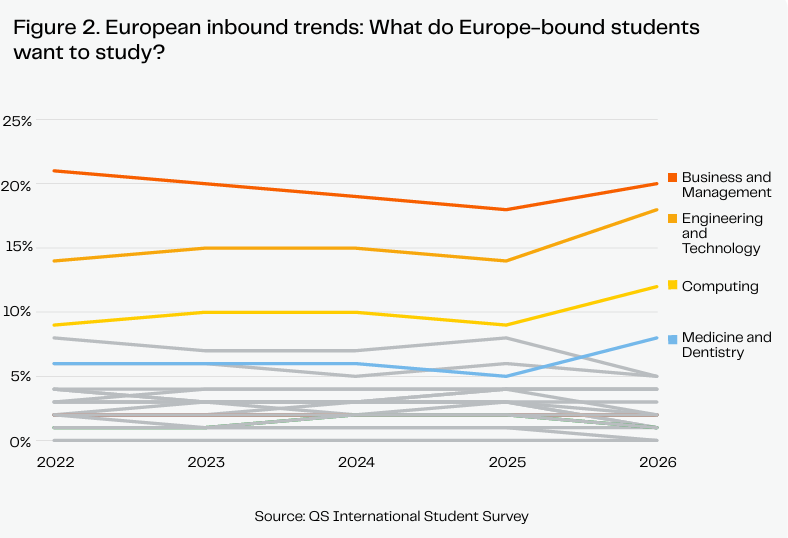
Engineering and Technology follows closely at 18%, while Computing accounts for 12% and Medicine and Dentistry 8%.
The direction of travel is important. Engineering and Technology has been gaining interest and could challenge Business and Management for the top spot if recent trends continue. Computing and Medicine and Dentistry have also seen an uptick in interest in 2026.
For universities, this reinforces the importance of looking beyond overall market growth and understanding where that demand sits at a subject level.
Students want quality, but Europe’s welcome and affordability matter too
The strongest reason students give for considering Europe is simple: they see it as welcoming to international students.
In 2026, the leading factors are:
- Welcoming to international students: 56%
- High-quality teaching: 49%
- Affordable cost of studying: 44%
- Affordable cost of living: 43%
- Strong reputation as a place to study: 41%
There are signs that priorities are evolving too. The importance of developing language skills has increased from 25% in 2022 to 29% in 2026, while proximity to home has risen from 5% to 8%.
Meanwhile, graduate employment opportunities and post-study work visas have become slightly less prominent factors over the same period.
Europe’s proposition, then, is not based on one thing. Students are balancing academic quality and reputation with welcome, value and the practical experience of studying abroad.
Growth alone won’t guarantee enrolments
The opportunity for European universities is substantial, but rising demand will also bring greater competition.
Institutions need to connect the programmes students want with the factors influencing their choices. That means sharper subject-level positioning, clear evidence of teaching quality and value, and demonstrating what the experience of joining an international student community will actually look like.
And once students make contact, speed matters too: 88% of Europe-bound students expect a complete and personalised response to an enquiry within one week or less.
Explore Student mobility and motivation: Europe for more insights into inbound and outbound student demand, decision-making and recruitment behaviour.