How can graduates stand out when everyone’s application looks perfect?
QS Midweek Brief - January 14, 2026. Is AI making it harder for graduate to stand out? And how does humility improve leadership?
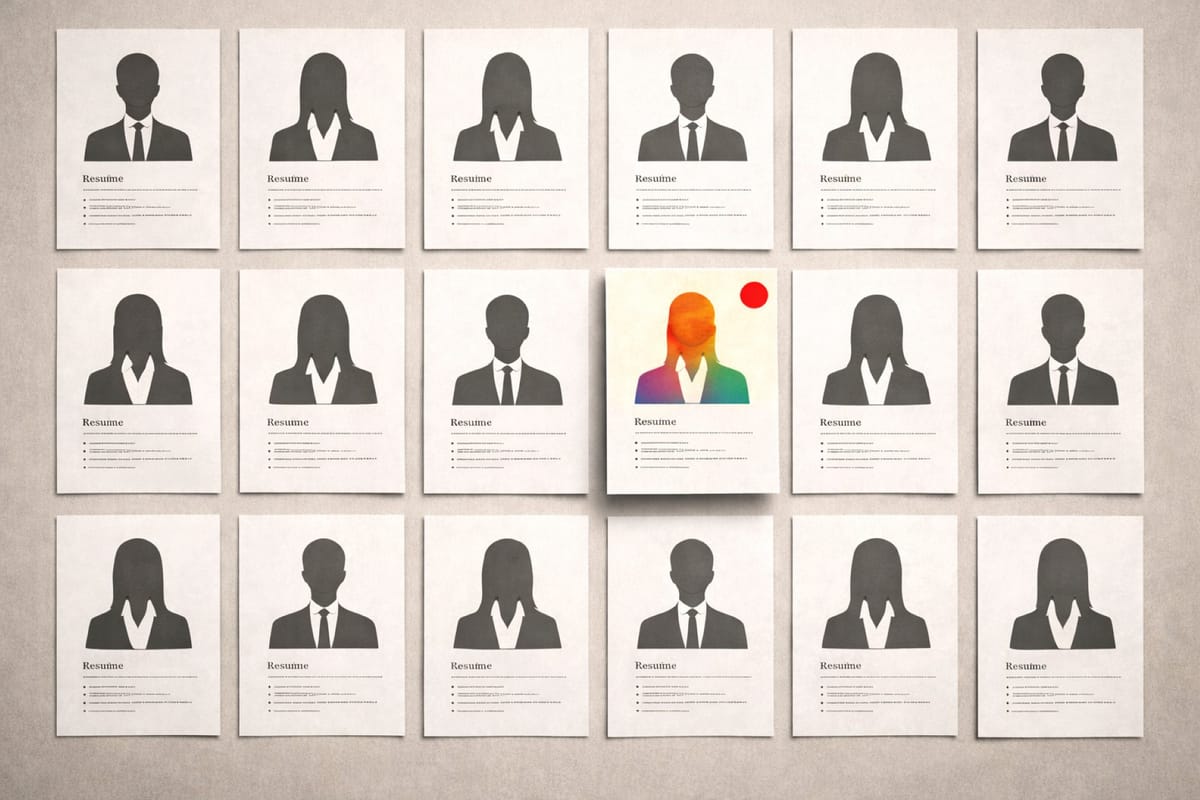
Welcome! I’ve said this a few times in the QS Midweek Brief, but I really feel for university graduates. They’re navigating a period in which things are simultaneously both the easiest and hardest they’ve ever been. When I was a graduate, for example, my biggest concern was writing a coherent resume without any mistakes. While spell check was useful, today’s graduates can use AI to not only remove mistakes but also optimise their resumes.
And yet the mistakes and sub-optimal resume that would have precluded me from securing a job can now help graduates stand out as desirable indicators of authenticity.
Of course, there are better ways for graduates to convey authenticity than scattering in the occasional typo or grammatical error, so this week, we look at how universities are helping them stand out when everyone else seems perfect. It’s a new year, and that means resolutions and new approaches, and we also include an essay on the power of humility in university leadership.
Stay insightful,
Anton John Crace
Editor in Chief, QS Insights Magazine
QS Quacquarelli Symonds
Navigating an AI saturated graduate job market
By Chloë Lane

In Brief
- AI-assisted applications have flooded the job market, overwhelming recruiters and making it the toughest hiring environment for graduates since 2018. The average number of applications per graduate vacancy is estimated at 140.
- Adaptability, problem-solving and resilience remain a competitive edge AI cannot replicate. Universities should help candidates prioritise showcasing their authenticity, verbal reasoning, and unique experiences to stand out.
- Higher education must teach a 'human + AI hybrid' strategy: use technology to polish, but leverage storytelling, personal insight, and networking to secure human connection and demonstrate value.
The graduate job market is overrun with perfect – but dull – job applications.
“We’re back at square one,” says Nav Dutta, Head of Career Development and Employment at Hult International Business School. “Instead of recruiters having to sift through hundreds of resumes to find qualified candidates, they now have to sift through hundreds of near perfect candidates.”
AI is now used by two thirds of jobseekers, a recent report from Career Group discovered. This relative ease of applications has led to more graduate job applications than ever before. The Institute of Student Employers estimates that the average number of applications per graduate vacancy is 140, a 59 percent increase on the previous year.
Even with so many of these near-perfect applications sent out, graduates in the UK are facing the toughest job market since 2018, according to job site Indeed, as employers pause hiring and use AI to cut costs. This stat is sadly true – 37 percent of managers globally have admitted they would rather hire AI than a Gen Z graduate, accounting to a recent Workplace Intelligence Survey sponsored by Hult International Business School.
As it becomes harder than ever for graduates to stand out, university careers services are adapting their services to help graduates navigate this new wave of AI applications.
From perfection to human
AI might be able to craft an error-free job application, but it can't give a graduate work-ready skills. Human skills – previously labelled soft skills – are something that AI can’t effectively emulate.
“[At Hult] we’re teaching students that in a time then everyone is flooding application portals with AI-assisted application materials, job seekers need to go back and play the human game,” says Dutta.
But in an online world where everything is instant, these skills can be slow to build, requiring patience and hard work. Becoming a highly sought after candidate in a saturated graduate job market takes time and effort. “The internet, YouTubers and Tik-Tokers will claim a job search can be done in 5 steps. It’s a lot more nuanced than that,” explains Dutta.
She advises students to work on skills like social and emotional intelligence, communication and influence, authenticity, and humility. Hult’s careers programming places a strong focus on developing a growth mindset and resilience to deal with the ups and downs of job hunting.
But AI does have its perks – and Hult’s careers team is using AI to beat it at its own game. They use AI tools to identify skills required for certain careers. Using this knowledge, they show students how to write accomplishment-driven resumes using Google recruiters’ XYZ method, encouraging them to use AI for feedback.
The key is blending the machine with the human element. When it comes to submitting the application, students are encouraged to find (human) hiring managers and present a compelling reason to have a short chat about their fit with the available job. This helps them demonstrate their verbal reasoning, real-time cognition and overall communication skills.
Olivia Trodden, Interim Associate Director of Careers and Employability at Kingston University, agrees that human skills are the way forward. “The differentiator will be human qualities,” she says, talking about how students can differentiate themselves in an AI-saturated job market. “Graduates who can clearly articulate their experiences, show adaptability and provide evidence of problem-solving in complex situations will stand out.”
At UK-based Kingston University, human-centric skills are embedded into every undergraduate student’s course as a core, taught and assessed part of their degree. The careers support at the institution is continually evolving to support students in a technology driven job market. Students receive guidance on how and when best to use AI.
“Our goal is to prepare graduates who are not only digitally competent but also adaptable and future-ready,” reveals Trodden. The ability to adapt is a key finding in the World Economic Forum (WEF)’s Future of Jobs Report 2025, in which 67 percent of global employers list resilience, flexibility and agility among the core skills their workforce needs.
A first step
Speaking from personal experience, University of Vassa alumna, Tiia-Maria Kinnula understands how AI can make applications easier and give students a starting point. When Kinnula started applying for new roles, she initially tried using AI to write her application letters. “But after I saw how my personality tended to disappear, I learned quickly to edit heavily and not rely on the first draft.”
Instead, when applying for jobs, she now uses AI to evaluate her CV and cover letter, asking it for feedback based on the jobs she’s applying to. Used too liberally, she warns, applications can be interpreted as fully AI by employers. But as a recruiter, she also sees the positives. “If students can use AI to support them in their application, maybe they are also adept at finding suitable ways to use AI in their daily work to improve efficiency. It is a valued skill, not just a tool for one thing.’
Kinnula has extensive experience in HR and recruitment, working with global technology companies. When hiring graduates, she cites motivation and human connection as the two most important things that can help students stand out in today’s market. This, she notes, is something that must be explained in graduates’ own words, not those of an AI chatbot.
Experience also cannot be overlooked. “As a recruiter I don’t expect candidates to have three years of experience after graduating, but I do expect to see motivation and willingness to develop yourself,” she says.
Maren Kaus, Director of Career Services at Frankfurt School of Finance & Management, says he’s seen how AI tools have transformed the first step of career preparation for students. “It’s a useful tool to polish job applications,” he says, “but there is a risk of losing authenticity.”
The key is to use it to organise ideas, but never to replace personal insight.
In workshops and individual counselling sessions, Frankfurt School helps students critically review AI-generated content, and ensure their own story, achievements and individuality come through. It also helps students to better understand how AI is used in recruiting processes, such as automated screening and keyword optimisation.
They too are working directly with employers to see what they are looking for beyond automation.
Chloë Lane is a gold-standard NCTJ-trained journalist specialising in higher education. A former Content Editor for QS, Chloë has a wide range of experience writing articles for a variety of B2B and B2C publications about topics related to business schools, universities, careers and academic research.
The quiet power of humility
By Lilian Ferrer, Professor and Manuel Orellana, Director of Finance and Management, Pontificia Universidad Católica de Chile, Chile

Across universities and organisations worldwide, the pace of change has accelerated. The pressure to deliver measurable results, publish and perform is intense. In such environments, humility can appear an unaffordable luxury. Yet humility may be the most sustainable form of strength we have.
In Spanish we often say soberanía sin soberbia, sovereignty without arrogance. It describes a quiet authority that influences without imposing and leads without dominating. This form of “inner sovereignty” allows leaders to guide with conviction while remaining open to dialogue and correction. In an age of constant visibility and competition, that balance is increasingly rare and increasingly necessary.
Even in academia, where reflection is valued, humility can be difficult to sustain. The metrics that define success, such as rankings, grants, citations, can easily shape our behaviour and our sense of worth. Through our own leadership experiences, we have learned how authority can isolate as much as it empowers. The intention to protect or accelerate progress sometimes silences dissenting voices or narrows the space for collective learning. Institutions proud of their excellence can unintentionally cultivate institutional pride: the belief that being the best means having nothing left to learn.
Recognising this has been one of our hardest lessons. Humility is not submission; it is care. It is the discipline of listening, of holding firm to purpose while remaining curious about other perspectives. When leaders stop listening, whether from exhaustion, conviction, or fear, their communities begin to fragment. When they listen again, trust and creativity return.
Leadership is, therefore, not only a matter of governance but of health; social health. The wellbeing of any organisation depends less on hierarchy than on the quality of its relationships. A healthy institution is one where people feel seen, respected and invited to contribute; where disagreement is not punished but processed; where excellence is shared rather than owned. These are also the foundations of social sustainability.
Sustainability is often discussed in environmental or economic terms, but there is a quieter dimension: the sustainability of our relationships. In the same way that ecosystems collapse when diversity is ignored, organisations decline when dialogue disappears. Leadership rooted in humility acts like an ecological buffer; it absorbs tension, allows regeneration and prevents burnout of both people and purpose.
The challenge is cultural as much as personal. Universities are full of talented individuals who have succeeded through mastery and perseverance. To ask them to lead with humility can seem counterintuitive. Yet the future of higher education may depend on it. Students and younger colleagues expect transparency, empathy and shared responsibility. They are not inspired by authority for its own sake, but by authenticity.
Cultivating such authenticity requires structural courage: valuing time for reflection as much as time for output; rewarding collaboration as much as competition; and recognising that listening is also a leadership skill. When humility becomes part of institutional culture, it reframes success; from control to connection, from visibility to impact.
We write this not from certainty but from experience, and from moments of error. There were times when we confused urgency with importance, or conviction with inflexibility. There were times when silence seemed easier than dialogue. What we have learned is that leadership is healthiest when it accepts imperfection as part of the process. The strength of leaders lies not in avoiding mistakes but in making space to repair them.
Humility also begins at home. Leadership, after all, is relational; it is practiced daily in the way we listen to our families, our teams and our communities. The patience required to guide a meeting and the patience required to guide a household come from the same source. Both are forms of care that sustain the common home we share.
To lead with humility is to understand that authority is temporary but influence through respect endures. Healthy leadership generates wellbeing that extends beyond institutions. It shapes professionals who replicate respect in their classrooms, hospitals, and public spaces. It strengthens the social fabric that allows societies to thrive amid uncertainty.
True sovereignty, then, is exercised not through control but through coherence, the alignment between values and actions. When power becomes care, leadership becomes sustainable. The question is not whether humility belongs in leadership, but whether leadership can survive without it.