How should higher education widen its gaze when familiar challenges keep repeating?
QS Midweek Brief - January 28, 2026. How can we reframe common challenges? And what strategies will bridge the internship gap?
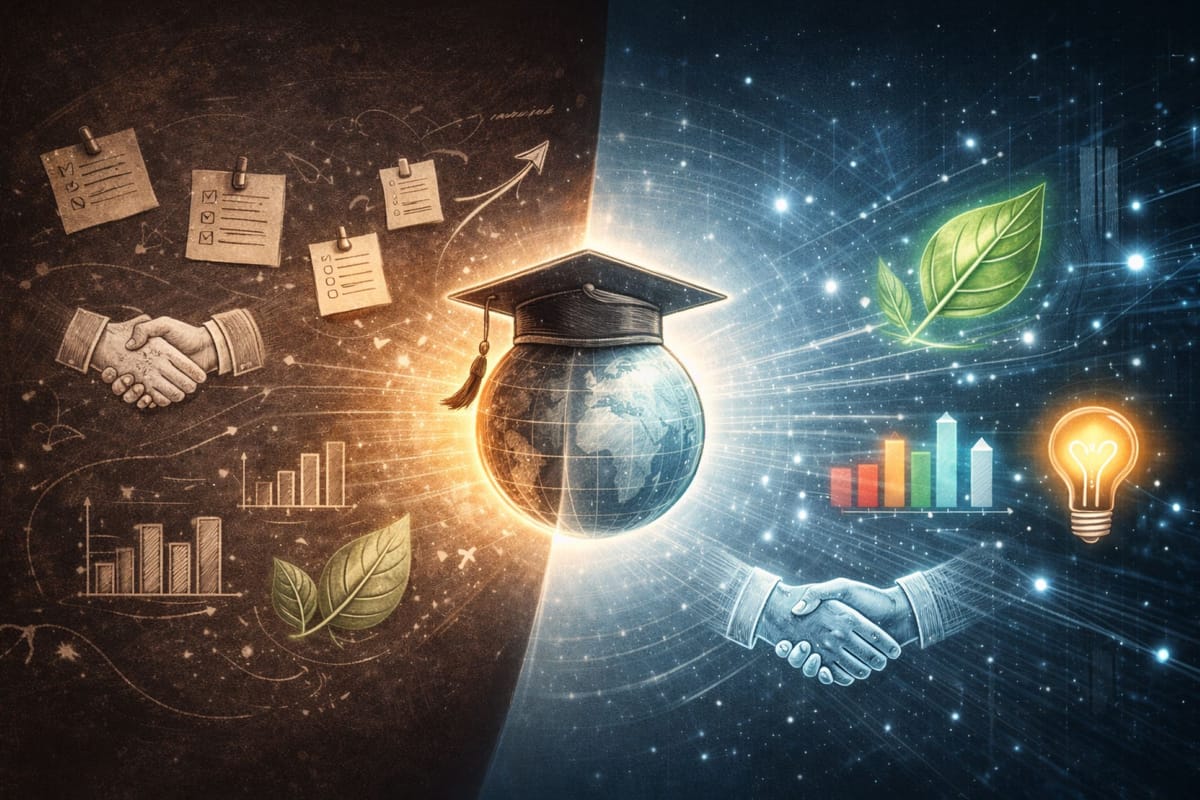
Welcome! If you took the viral 2016 trend, in which social media users reflect on their lives a decade ago, and applied it to international education, what would be different? Going over reporting from back then, clear highlights include: new international education strategies, priorities for sustainable growth, calls for better employer/institution relationships, increased interest in data. Sounds pretty familiar.
This week, as we continue showcasing thought leadership on what to keep an eye on in the year ahead, we ask: if the problems are common, how can we widen our gaze? We also explore how AI is widening the internship gap and what can be done to overcome it.
Stay insightful,
Anton
Viewing common problems anew
By Isobel Rossiter, Principal Consultant, QS Quacquarelli Symonds

Student recruitment can often feel like a carousel, constantly turning, rarely slowing and leaving little space to pause or reflect.
At times, it can be disorienting, making it hard to feel certain about direction. Yet in a climate where the global order feels increasingly unsettled, and unpredictability has become almost predictable, data and insight offer a sense of stability. They provide a calm, grounding force, something to hold onto and to focus our attention.
In a world where trust, authenticity and credibility are being questioned, the pursuit of truth in higher education feels more important than ever. In 2026, this is something I will be actively seeking and representing. There is a real opportunity for those of us working in higher education to surface data-driven truths. To offer insights that enable universities, governments and students to make decisions based on strong, credible information and shared knowledge.
This also requires encouraging and allowing ourselves to pause, breathe and reflect on our direction. It means taking a mirror to ourselves and unpicking our own data, alongside sector-wide insights, to benchmark where we are, to recalibrate our approach and refocus on how and where we can drive the greatest impact. To gain understanding we need to understand our lived experiences and be prepared to confidently take a telescope to the future. By doing this we unlock powerful catalysts for change.
Student recruitment is ultimately about the why, the what and the how. Each cycle, we search for the next defining moment, often assuming that progress must come from something big or transformative. But my focus in 2026 will be on challenging that assumption. Sustainable, measurable success is often built through consistency, continued focus and small, intentional steps. These allow the space and time for people to truly explore, engage, and enact meaningful change.
For me, 2026 is about widening my gaze, not just looking straight ahead or analysing what has been and gone, but also looking sideways and upwards to assess the art of the possible. For me, this broader perspective is essential if we are to understand how the student recruitment landscape must evolve to ensure a sustainable future.
Data holds many of the answers to higher education’s most pressing questions, but data alone does not create understanding. The year ahead is about using the rich data we hold in student recruitment more wisely: as a driver of curiosity, an enabler of insight and a foundation for collaboration and shared learning. It is about moving beyond the immediacy of the present and actively shaping a longer-term future.
Yes, the world feels unpredictable, and yes, the carousel keeps turning, but the art of the possible emerges when we allow ourselves to pause, take stock and imagine something better. A future shaped by our research, our partnerships, our data and, most importantly, our students.
These reflections may sound like the words of a dreamer, but dreams are simply goals we are willing to strive for. As many of us who have spent a long time in higher education know, with the right mindset and a shared sense of ownership and commitment, those dreams can become actionable goals and ultimately deliver real change and impact.
So, in 2026, my focus will be firmly on the individuals, institutions, innovations and inspirational stories that are moving the dial in higher education. Learning from them and with them, building understanding to understand what comes next, and driving that spirit of curiosity to develop my own thinking and practice, and celebrating that progress even while the carousel keeps turning.
Isobel Rossiter is a Principal Consultant in the Sector Intelligence Unit of QS. Isobel has over 20 years of experience working in UK and Canadian universities, leading student recruitment and admissions divisions, most recently as Vice President of QS’ University Branded Services Division. Isobel specialises in executive leadership, strategic development and operational delivery of international and domestic student recruitment in higher education.
The internship gap meets the AI divide
By Jillian Low, Chief Strategy Officer, Virtual Internships

Employers are increasingly clear about what they value. In WGU’s 2025 survey of more than 3,000 US employers, 78 percent said work experience matters as much as or more than a degree, yet fewer than four in ten believe higher education is preparing learners to succeed. AAC&U’s 2025 research reinforces the gap: the top skill employers seek is the ability to apply knowledge in real-world settings.
Employers are telling us exactly what they're looking for. Internships are the clearest mechanism universities have to deliver it: a structured environment where learners gain work experience, develop judgment and demonstrate real-world application while still completing their degree.
But internship supply has never matched demand. In 2024, BHEF found that 8.2 million learners wanted an internship. Only 2.5 million got a quality one. This scarcity existed long before headlines like The Atlantic's "The job market is hell" or The Wall Street Journal's "Companies predict 2026 will be the worst college grad job market in five years" started circulating.
AI hasn't caused the internship gap. But it is accelerating the pressure. Handshake reports that applications per internship posting have doubled since 2023. The Brookings Institution notes that postings themselves are down 17.5 percent over the past year. Competition is intensifying on both sides: more learners chasing fewer spots, while employers weigh whether the investment is worth the effort.
What’s new in 2026 isn’t the supply problem. It’s what’s happening inside the limited opportunities that do exist. Most conversations focus on access to internships; far fewer are paying attention to how AI is quietly changing the quality, expectations and outcomes inside the ones students actually get. AI is also a major accelerant for institutions to introduce STEM-plus programmes. A report released last month by the Global Consortium on Artificial Intelligence and Higher Education for Workforce Development, comprising the US’ Institute of International Education (IIE) and the Doha-based World Innovation Summit for Education (WISE), urges universities to review policies and governance to integrate AI in teaching and learning. The report presents a comparative analysis of seven global case studies examining AI integration in higher education.
The tale of two interns
In research conducted through Virtual Internships, which guarantees structured internships with real companies for university learners globally, across thousands of placements, we surveyed interns and supervisors across five continents who had completed placements in the last six months. We wanted to understand how AI is actually showing up inside internships, and what outcomes it's producing.
AI use in internships is no longer exceptional. It’s the norm. Nearly nine in ten companies actively encouraged interns to use AI, with interns applying it across drafting, research, analysis and iteration in nearly every task category.
The second finding was more complicated. When we asked supervisors how satisfied they were with how interns used AI, 81 percent said somewhat or very satisfied. That sounds like a success story. When we dug deeper, a gap emerged. Interns were far more confident about the impact of AI on their work than their managers were. Confidence was outpacing competence.
The interviews added texture. What we kept hearing was a split. One intern would use AI to get unstuck, move faster and ask better questions. They didn't take outputs at face value. They edited, checked and applied judgment. AI amplified their performance.
Another intern, same tools, same access, would use AI without that layer. Their work stayed flat or slipped. In some cases, supervisors started asking a harder question: if the intern is just prompting without context or insight, why hire them at all?
A leader at a Global Healthtech Company captured the divergence in a single story:
"We usually give a lot of tasks and just kind of feel how much someone can go through. The one on a four-week assignment, I know, was using AI, knew how to use it really effectively, crushed the assignments, went through everything. And then the eight-week intern, we didn't even finish the first task, and she had the same list. The acceleration with someone using AI versus someone not, and using it right, is massive, absolutely massive."
That divergence became a core finding, published in our Future-Ready Talent Series. We started calling it the “tale of two interns”. Same opportunity. Same tools. Outcomes shaped entirely by judgment.
For the interns who used AI well, the experience changed what an internship could be. They moved past administrative tasks into complex problems faster. AI filled knowledge gaps in real time, letting them contribute at a higher level sooner. One intern studying at the University of Southern California put it simply: "AI made my work more manageable. It gave me a foundation, and I carried out the rest."
That optimism showed up in the data too. 71 percent of interns said AI would make it easier to obtain an internship or employment in the next 12 months. They weren't anxious about AI. They saw it as a competitive edge.
AI doesn't just make interns faster. It changes what an internship can be. But only for those who use it well.
Could 2026 bring the tale of two institutions?
The “tale of two interns” is already happening. Same tools, same access, divergent outcomes based on judgment. That's observable now.
What I’m keeping an eye on in 2026 is whether that pattern scales up. Could we see a “tale of two institutions” emerge?
One institution teaches learners how to apply critical thinking and judgment to AI in workplace contexts, not just how to use the tools. It builds durable skills alongside AI fluency: communication, adaptability, problem-solving, the human layer that makes AI output useful rather than risky. And it provides access to experiential learning that actually tests those skills, internships of real duration with real companies, not micro-projects that disappear in a week.
For employers partnering with that institution, something shifts. Interns get unstuck faster. They move past admin into complex work sooner. They need less hand-holding because AI fills knowledge gaps and structured support fills judgment gaps. The management burden drops.
If the burden drops, could employers take on more interns? Not because they're doing charity, but because the ROI changes. Interns who are prepped, supported and amplified by AI deliver more value with less friction.
If that happens at scale, AI stops being the thing that threatens internships and starts being the thing that expands them. The ecosystem grows instead of contracts. Instead of continued fear and loss, we get gains.
The other institution treats AI as a separate conversation. No integration into preparation. No structured guidance during placements. In our research, 30 percent of interns received no AI training at university, and nearly a quarter said their institution's stance made them fearful enough to avoid using it. Internships remain a black box. The divergence we're already seeing at the intern level compounds, invisible and unaddressed. Employers get inconsistent results and start questioning whether the investment is worth it. Supply continues to decline.
I don't know if 2026 is the year this split becomes visible. But the conditions are there.
What I'm watching for
If the hypothesis holds, there are signals I'll be looking for this year:
From employers: Are companies increasing intern intake when structured support is in place? Is the conversation shifting from "AI or intern" to "intern amplified by AI"?
From institutions: Are universities embedding AI into internship and degree preparation, or still treating it as a separate curriculum problem? Are they building visibility and feedback into placements, or leaving AI use as a black box?
From the data: Does supply start to move? Not because employers suddenly became generous, but because the friction dropped enough to change the math.
The “tale of two interns” is already here. Whether the tale of “two institutions” follows is what I'm watching in 2026.
Jillian Low, Chief Strategy Officer, Virtual Internships Jillian is Chief Strategy Officer at Virtual Internships, a Series A EdTech company expanding access to structured, employer-hosted internships globally. She has 15 years’ experience across education-to-employment initiatives, focusing on applied AI, experiential learning, and workforce outcomes, and holds an MA in International Education from UCL.