
Indian student demand is broadening beyond traditional STEM subjects
Business remains the biggest subject area, but health-related subjects are gaining ground. What else matters to Indian students choosing where to study?
Business remains the biggest subject area, but health-related subjects are gaining ground. What else matters to Indian students choosing where to study?
Hello,
India is already one of the world’s biggest sources of internationally mobile students, and QS Global Student Flows projects more than 900,000 Indian students will be studying abroad by 2030.
But understanding the size of the opportunity is only part of the picture. Our latest QS International Student Survey data shows how the subjects Indian students want to study are changing, and what increasingly matters when they choose a destination.
Business remains the biggest draw, but subject demand is broadening
Business and Management remains the most popular subject area among prospective Indian students, accounting for 24% of interest in 2026. Engineering and Technology follows at 17%, with Computing at 12%.
But beneath those headline numbers, the mix is changing.
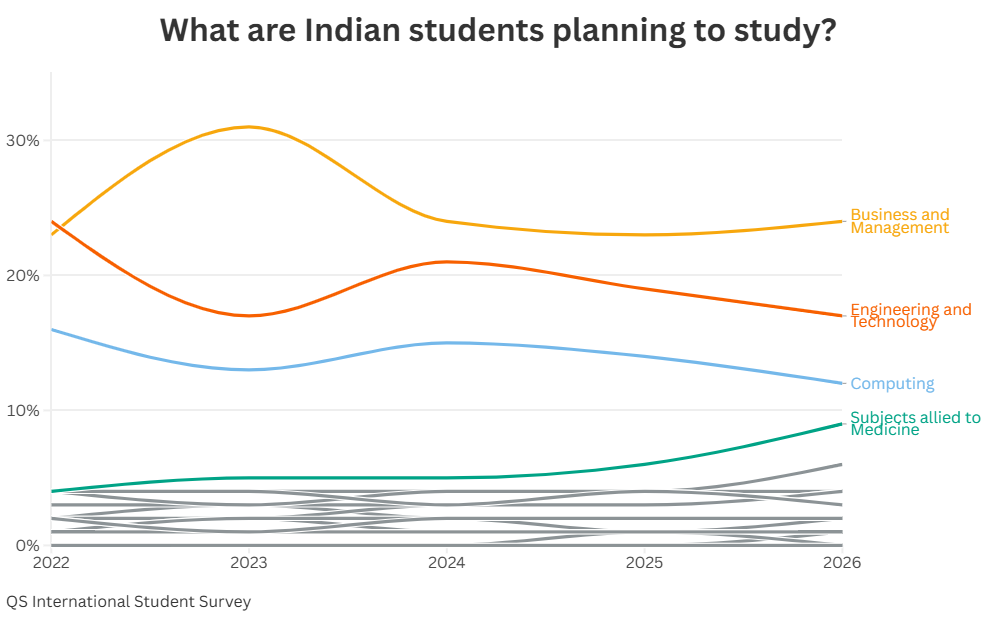
Since 2022, Engineering and Technology has fallen from 24% to 17%, while Computing has declined from 16% to 12%. Meanwhile, interest in Subjects Allied to Medicine has more than doubled, from 4% to 9%, and Medicine and Dentistry has increased from 4% to 6%.
Indian student interest appears to be gradually broadening, creating opportunities for institutions to look beyond their established recruitment strengths.
Quality and welcome now sit at the heart of destination choice
What Indian students want from a study destination is changing too.
In 2026, the two leading factors are:
- Welcoming to international students: 57%
- High-quality teaching: 57%
They are followed by a destination’s reputation as a place to study at 48%, well-ranked universities at 47%, and the opportunity to build a network of connections at 46%.
Some traditionally prominent practical factors have become less influential. Graduate employment options have fallen from 52% to 41% since 2022, while post-study work visa access has declined from 46% to 35%. At the same time, cultural and lifestyle appeal has risen from 33% to 38%.
The picture is becoming more rounded: Indian students still care about outcomes, but they are increasingly weighing those outcomes alongside academic quality, reputation, welcome, networks and the wider study experience.
The India opportunity: rethink both the programme and the proposition
For universities recruiting in India, the opportunity is not simply to promote the subjects that have historically attracted the most demand.
Business, Engineering and Computing remain major markets, but growing interest in health-related subjects points to a broader recruitment opportunity. And whichever subject an institution is promoting, the proposition increasingly needs to show students why they will receive a high-quality education, feel welcomed and build valuable connections while studying there.
Read Student mobility and motivation: India for the full analysis of subject demand, decision factors and the student research journey.