
Students are demanding more than climate action: are universities ready?
QS MidWeek Brief - December 3, 2025. Student activism on campus has evolved. How can universities address demands? And reflect on the power of collaboration.

Welcome! Last week, we spoke a little about the sustainability expectations of students, particularly that over three-quarters would prioritise sustainability over a university ranked in the top 1,000. But, we couched most of our discussion around skills acquisition.
This week, we take a deeper look at what students are asking for – and in some cases protesting over – on campus, to discover that their demands have evolved beyond just climate activism. There is a clear focus now on social impact as well.
As we wind down to the end of the year, University of Auckland Vice-Chancellor Professor Dawn Freshwater pens a poignant piece reflecting on how far we’ve come through partnerships, and where to from here.
Stay insightful,
Anton John Crace
Editor-in-Chief, QS Insights Magazine
QS Quacquarelli Symonds
Standing with students
By Claudia Civinini

In Brief
- Climate justice movements now tackle intersectional issues like migrant rights and authoritarianism, pushing universities beyond symbolic divestment towards practical change and defending the right to protest.
- While 80% of UK universities now commit to fossil fuel divestment, ethical careers and recruitment scores remain low (19% on average). Activists are also demanding practical measures like sustainable food options and breaking ties with the border industry.
- Universities must choose to defend academic freedom and innovation by standing with students against political threats, or risk damaging their reputation among young people.
When Alicia Colomer started college in 2020, the student climate movement looked quite different.
“The only thing we were pushing for was divestment,” she recalls.
Now, she’s Managing Director of the Campus Climate Network (CCN) in the US, and while university divestment in fossil fuels is still an area of focus, she says the movement is now expanding. Students are asking for more practical measures to fight climate change, and climate movements are broadening their scope to focus on social justice; or, in some cases, to protect the very right to protest.
“Right now, there is a huge attack on higher education in the United States,” Colomer explains. “A lot of our efforts in the past year have shifted towards not only focusing on climate, but also focusing on authoritarianism and how it shows up on campus, and how we can fight back.”
CCN, together with other organisations, launched a day of action on 7 November across US campuses.
“It's no longer just about climate… it's about the very right to be able to protest and organise for those issues in the first place,” she says.
But within CCN’s focus on antiauthoritarianism, the sector’s climate leadership is still a key area. Fossil Free Research is an ongoing campaign, and so are divestment efforts, although Colomer says the organisation has noticed that some students are moving away from divestment as some schools have not shifted yet.
A lot of organisations, she explains, are now pushing for a Green New Deal for campus, which can include measures that affect students more specifically than big-picture, symbolic ideas such as divestment.
These more practical measures include plant-based food options on campus, requiring students to take a course in climate change, or ensuring that new and existing buildings are energy efficient and use renewable energy.
Bridging gaps
Sustainable food is a new area of focus for student climate activists in the UK as well.
People & Planet, a UK student network organisation running campaigns for social and environmental justice, added a new criterion about food options to their 2024/25 University League in collaboration with Plant Based Universities.
The People & Planet University League has been running since 2007, comparing and ranking UK institutions on their performance on a number of criteria regarding sustainability, workers’ rights and migrant justice.
“[Sustainable food] is definitely something that students are demanding on their campuses,” Josie Mizen, Co-Director, Climate Justice at People & Planet, says. “There are universities out there that are doing quite well in that area, but a lot that have not really thought about food as a particular aspect at all yet.”
People & Planet focuses on three ongoing campaigns, all chosen by the student network and operating in multi-year cycles. The Fossil Free and Fossil Free Careers campaigns aim to encourage universities to divest from fossil fuel industries and exclude them from university careers and recruitment activities.
Another campaign, Divest Borders, seeks to extend the logic of the fossil fuel divestment movement to the border industry, companies that profit from immigration detention, surveillance and deportation, Mizen says.
“Our main goal has really been about continuing to put pressure on universities to cut ties with these extractive industries,” she explains.
Like the US, the UK’s climate movement is also broadening its focus.
“We've noticed that students really care about furthering climate justice on their campuses, but also increasingly recognising the ways in which the climate movement intersects with other forms of injustice – that could be social, migrant, or economic. Students really want to work on these things in conjunction,” she explains.
A key goal of the organisation, she says, is to bridge the gap between two movements that historically have been separate.
“We see an important role for People & Planet as one where we can put forward why these movements need to coexist with each other and why you can't have climate justice without also having migrant justice and vice versa.”
Energy intensive
While there is an argument that AI tools can be leveraged to tackle climate change, their environmental impact is becoming evident.
Some groups are beginning to organise on the issue. For example, at the University of Michigan, a student group is raising awareness of the environmental impact of AI, while a CCN partner organisation is holding a meeting later this month, led by staff and scholars, to talk about the environmental, social, economic and political threats posed by AI. There have been student campaigns against data centres in the US, but Colomer says AI is not a priority at the moment, although the situation might change.
Mizen says that, as an organisation, AI is something People & Planet are worried about.
“Firstly, in terms of the resource use of AI, which is extremely energy intensive. But it is also funnelling money into companies that are fronted by billionaires and multimillionaires who are then using their influence and power to peddle climate denial, far-right and anti-immigration rhetoric,” she explains.
“We are extremely worried about it.”
While she says there is currently no network-wide campaign about AI, it may be something that students choose to work on in the future, although that’s hard to predict at the moment.
“AI could end up becoming embedded in our universities in ways that perpetuate injustice, but there could also be a much more organic resistance to it, as people realise the value of not engaging with it unless absolutely necessary,” Mizen explains.
“Potentially, as the harmful impacts of AI become clear, people might start to not use it.”
A teacher turned education journalist, Claudia has been writing about international education for the best part of 10 years. Originally from Italy, she worked and studied in Australia before moving to the UK in 2014. As a journalist, she worked for publications in the education sphere such as EL Gazette, The PIE News and Tes, specialising in research and data-led reporting, before going freelance in 2021. She holds an MSc in Educational Neuroscience and is passionate about education research.
Reflections on partnerships
By Professor Dawn Freshwater Vice-Chancellor, Waipapa Taumata Rau, University of Auckland
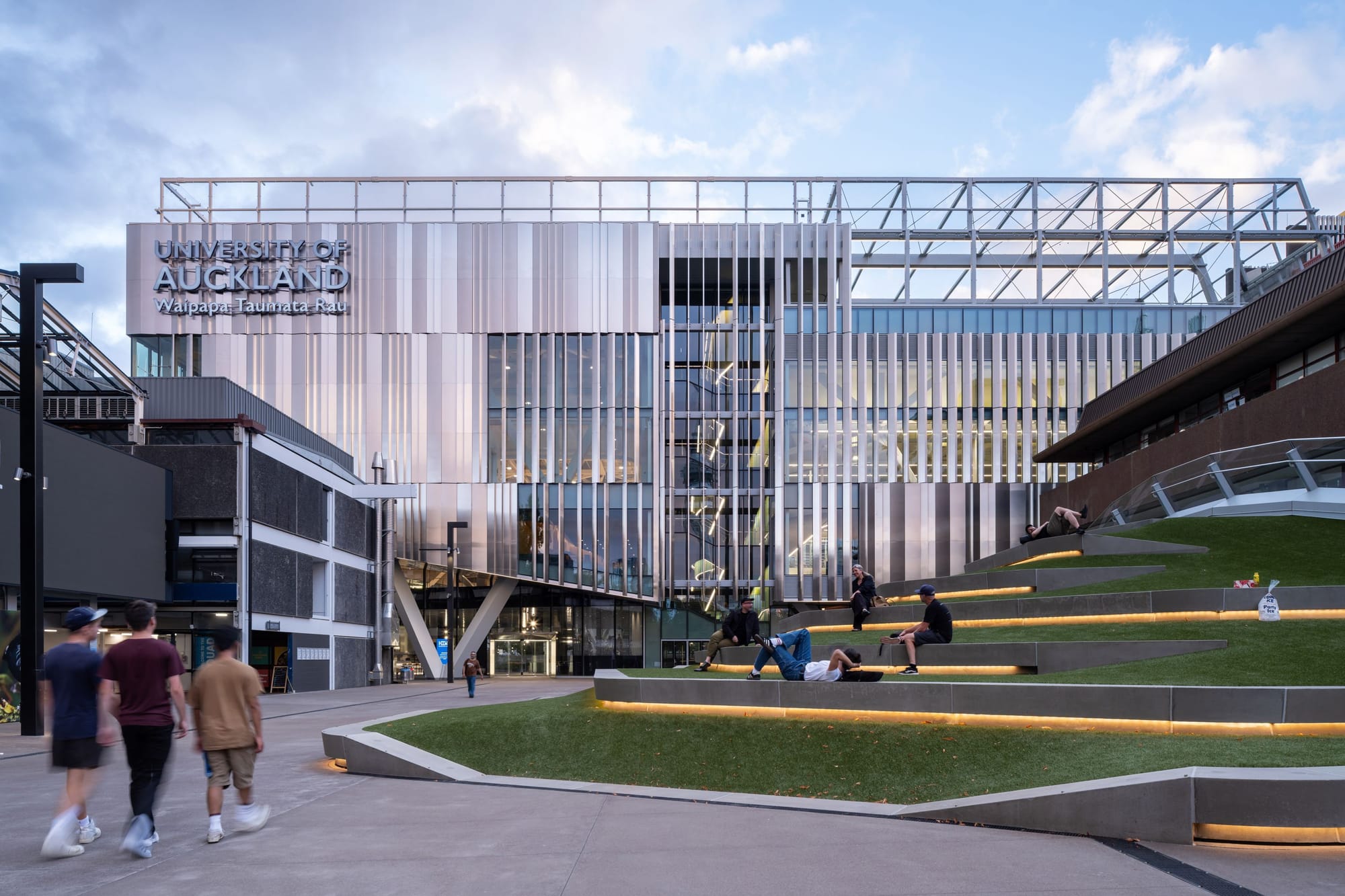
As the year draws to a close, it is a timely opportunity to reflect on the moments that have lifted our spirits. For me, one such moment was the opening of Waipapa Taumata Rau, University of Auckland’s Hiwa, the institution’s new recreation centre. A student-driven project more than a decade in the making, it has recorded more than a million visits in less than a year. It stands as a place of excellence and inspiration, and a reminder of what shared ambition and hope can achieve.
What Hiwa represents is an antidote to the general malaise that pervades our society today.
As a former health professional, I recall “malaise” as a term used to describe a vague sense of discomfort or unease, not quite a disease but a weariness of spirit. Who among us hasn’t felt this in recent years? The wider social equivalent is everywhere: a low-level disenchantment that manifests in mistrust, polarisation, and fatigue.
Higher education is not immune. Universities once sat beneath a canopy of trust. Today, that canopy has thinned. Science itself faces scepticism, even hostility. Public faith in expertise and education is eroding at the very moment the world needs critical thinking, imagination, and moral courage.
So, how do we respond?
First, we must agree that thinking itself matters. It is not a task to be outsourced. In an age where algorithms anticipate our thoughts, contemplating risks is becoming an artefact of history. Yet the life of the mind remains one of humanity’s greatest tools for renewal.
Eleanor Roosevelt once said, “Great minds discuss ideas; average minds discuss events; small minds discuss people.” Social media has flipped that hierarchy. It thrives on gossip, outrage, and distraction, the opposite of reflection.
If we are to rebuild trust, universities must confront their own distortions. Minds, like mirrors, can warp what they reflect. We may believe we are seeing the world clearly, when in truth we are gazing at a distorted version of ourselves. Too often, institutions look at their communities rather than with them.
True partnership requires us to step away from the mirror. Partnership is not transactional. It is not about looking across a table; rather, it is about being together: sharing a vision, insight, and purpose. It is, in the truest sense, about beholding, that is, recognising one another not as objects of analysis, or targets of messages, but with authentic and genuine appreciation of our peers with equal value and agency.
This calls for ethical and authentic collaboration. It requires us to rebuild trust, to find common cause with students, caregivers, iwi (tribes), community groups, businesses, policymakers, and global peers. Collaboration is not about telling or showing, it is about being, feeling, creating and finding solutions together.
At the University of Auckland, several recent initiatives show what this looks like in practice.
In 2022, we signed a Kōtuitanga, or Memorandum of Understanding, with local iwi Ngāti Whātua Ōrākei, which has seen university and iwi leaders collaborate on strategic planning, programmes, activities, cultural narratives, language, and ways of being.
An innovative partnership with Auckland’s Eden Park stadium has fostered local and global community connections while integrating research, teaching, and learning with one of the city’s most dynamic and beloved venues.
A diverse group of partners is now forming around the University’s Newmarket Innovation Precinct, which, with industry, business, the Auckland Business Chamber, the Auckland Council and our research and startup communities, promises to build a shared foundation for the region’s innovation ecosystem.
By engaging authentically and taking the time to establish genuine long-term relationships, we will, with our partners, create the bonds of a civilised and humane society.
Hiwa reminds us what happens when we do. A student idea became a collective achievement. A building became a symbol of trust, collaboration, and renewal. In an age of malaise, that is the kind of story worth telling, and retelling, until it becomes the new normal.