
The most automatable US jobs likely to see low growth through 2030
AI exposure does not necessarily mean fewer jobs. New QS analysis suggests the bigger divide is between work that AI can augment and work it can automate.
AI exposure does not necessarily mean fewer jobs. New QS analysis suggests the bigger divide is between work that AI can augment and work it can automate.
Generative AI is already reshaping the US labor market, but its impact will not be felt evenly across occupations.
QS analysis of 1,870 occupations and 50,000 skills finds that more than 60% of roles are expected to see some level of growth through to 2030. Those growing roles are more likely to be ones where AI complements human capability rather than replaces it.
Automation risk rises as job growth falls
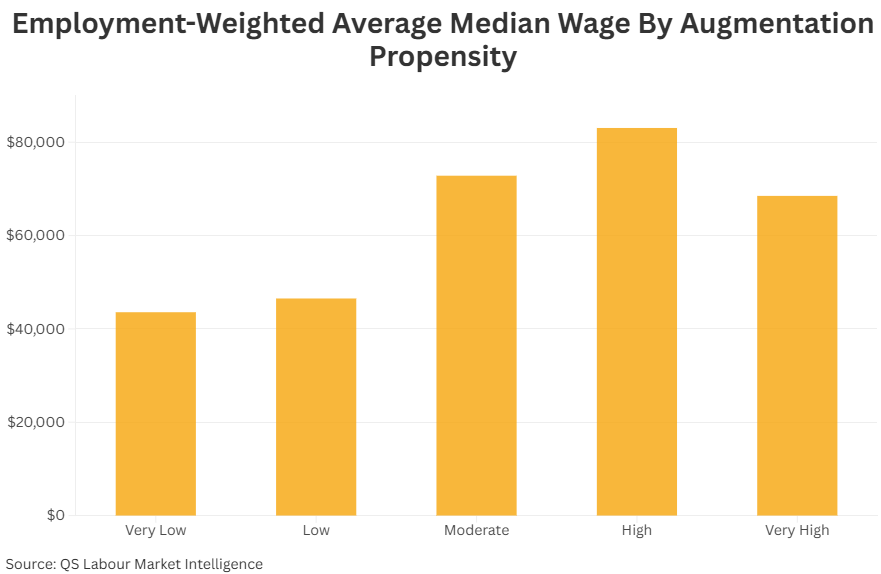
The pattern is particularly clear when occupations are grouped by their propensity for automation.
Roles with very high automation potential are expected to experience very low growth by 2030, while growth is concentrated among occupations with lower automation exposure.
By contrast, roles with high potential for AI augmentation continue to grow. Data scientists and AI engineers, for example, sit among the most augmentable occupations and are also among the fastest-growing. AI augmentation can make people more productive without removing the need for the person doing the job. Automation is more likely to affect routine and rule-based tasks, particularly where there is less need for interpretation, creativity or judgement.
The fastest-growing roles also look different
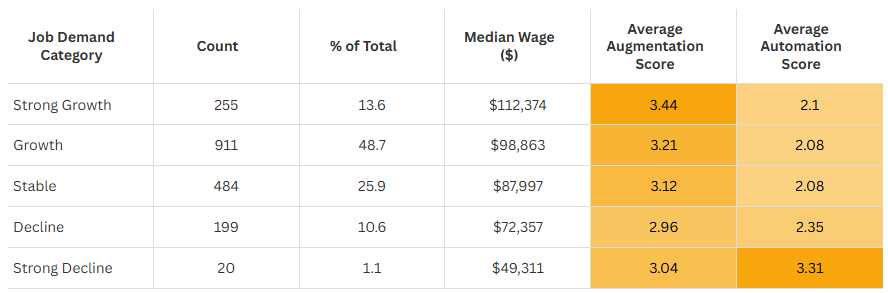
The wider labor market data tells a similar story. Occupations classified as showing strong growth have a median wage of $112,374, an average AI augmentation score of 3.44 out of 5, and an automation score of just 2.10.
For roles in strong decline, median wages fall to $49,311 and the average automation score rises to 3.31.
What does this mean for higher education?
Graduates now must be prepared for an AI-enabled labor market. This will require a combination of technical skills, but - more importantly - soft skills like critical thinking. Learn more about the biggest skills gaps in the QS World Future Skills Index 2027.
Explore The Emergence of the Augmented Workforce Economy Index 2027 for the full analysis of AI automation, augmentation and the future of jobs in the US.