
The next phase of skills-first is infrastructure, mobility, and proof
Skills-first is evolving. The next advantage is how well your system connects.
What’s changed?
Mobility patterns are shifting, and so is how learners evaluate return on investment. In QS’s new Global Student Flows: United States briefing, one data point stands out for any leader competing for talent: 69% of prospective students say university reputation matters when choosing where to study (and 54% say it matters when choosing a course).
Reputation is increasingly earned through outcomes: credible skills signals, work-based learning, and pathways that still work when jobs evolve.
Agenda updates
- Build the underlying infrastructure
Building the skills infrastructure: how technology connects learning, employers, and workforce systems
How interoperable systems enable skills development and signalling across the education-to-work continuum. - Scale outcomes beyond pilots
From pilots to pathways: how philanthropy is supporting systems for underserved learners
Where investment is shifting when the goal is measurable mobility and attainment at ecosystem scale. - Redefine the early-career on-ramp
What does entry-level mean now? Rethinking early career pathways
Where pipelines are breaking, what capabilities matter most, and what new models create real entry points. - Measure the human advantage
What Technology Can’t Replace: The Evolution of Durable Skills
How to embed, assess, and signal durable skills alongside technical capability. - From Access to Impact: Scaling Applied AI Education Across America’s Community College Network
Community colleges are uniquely positioned to scale applied AI education quickly. This panel explores how colleges are aligning curricula with employer demand, building industry partnerships, and delivering measurable workforce impact through practical, career-focused AI skills. - The State-Employer Compact: Scaling Internship Pathways Through Partnership
A discussion on how governments, employers, and institutions can collaborate to expand high-quality internships and work-based learning. Speakers will share scalable models that connect policy, funding, and employer demand. - The Modern Anchor Institution: Bolstering Economic Growth Through Talent, Innovation, and Place Partnerships
Universities are increasingly central to local economic resilience. This session explores how institutions strengthen talent pipelines and innovation outcomes through place-based partnerships with regional employers and public-sector stakeholders.
Fast Fact
Delivery models are changing too. The same report notes that more than 54% of US college students took at least one online course, with a sizeable share studying fully online. That shift is reshaping expectations around flexibility, skills recognition, and hybrid pathways.
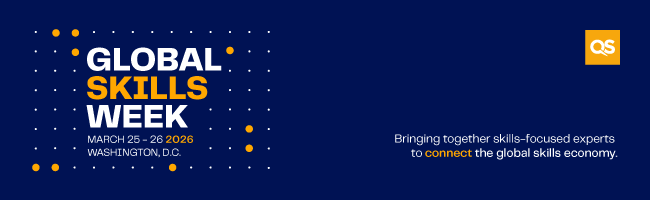
Global Skills Week 2026
March 25-26 | Convene Hamilton Square, Washington, D.C.
If you’re working on skills-first strategy, employability outcomes, mobility, or pathways for underserved learners, Global Skills Week is built to help you move faster with peers facing the same constraints.
Looking forward to seeing you there.
Best wishes,
QS Team