Why are some universities choosing infrastructure-first internationalisation over traditional city destinations?
QS Midweek Brief - July 29, 2026. Could the purpose-built study hub challenge traditional cities in the Best Student City rankings? And should we worry about being hypocrites?

Welcome! Last week, QS released the latest edition of its Best Student Cities Rankings, with Seoul coming out on top for the second year in a row. While there’s a wide range of considerations that go into making an existing city a student city, there’s a new student-focussed city emerging. Offering purpose-built infrastructure, our top story this week finds out that these hubs not only meet students’ needs in areas such as employability and study flexibility, but also often meet national strategies.
We also look at the seemingly contradictory point that as powerhouses of sustainability research, universities are also large contributors to unsustainable practices. Could there be more to it than meets the eye?
Stay insightful,
Anton John Crace
Editor in Chief, QS Insights Magazine
QS Quacquarelli Symonds

Beyond the Global City
By Gauri Kohli

In brief
- International education is shifting from traditional cities toward purpose-built hubs designed for long-term national strategy.
- These zones provide shared infrastructure and regulatory ease, allowing universities to focus on industry and teaching.
- Future winners must evolve from mere real estate developments into integrated ecosystems that drive regional economic growth.
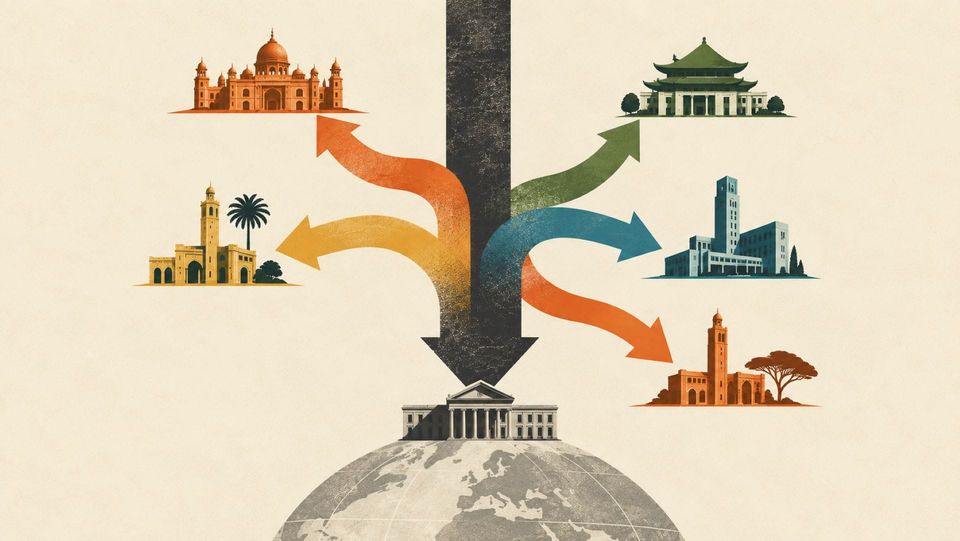
For decades, international higher education was a story about cities such as London, Sydney and Singapore. That’s changing. Governments aren’t waiting for these cities to grow into destinations on their own anymore; they’re building purpose-driven hubs from scratch.
Alongside QS’s own Best Student City rankings, a growing share of internationalisation is now happening outside that competition altogether - in hubs like Education City, EduCity Iskandar and GIFT City.
Dubai International Academic City (DIAC) makes the point starkly: 27 branch campuses and 28,000 students on a single square mile - a density unthinkable in a traditional university city a generation ago.
The trend holds globally too. C-BERT data puts the number of international branch campuses at nearly 384 across 85 countries in 2026, up 15% from 333 in March 2023, while UNESCO counts more than 6 million students studying outside their home country.
That growth is increasingly landing not in established university cities but inside purpose-built zones - Education City in Qatar (home to Georgetown and Carnegie Mellon, among others), EduCity Iskandar in Malaysia (Newcastle University Medicine, Raffles University), Incheon Global Campus in South Korea (George Mason University, University of Utah), and most recently, GIFT City in India, which has already attracted Deakin University and the University of Wollongong.
The real question isn’t how many campuses are being built, but why governments and universities increasingly favour infrastructure-first internationalisation over letting it happen on its own.
A deliberate geography
Professor Christopher Ziguras, Director of the Centre for the Study of Higher Education at the University of Melbourne in Australia, traces the model back to the early 2000s, when international branch campuses began clustering inside new urban development projects.
Some are explicitly education-led - like Qatar's Education City - while others sit inside broader mixed-use developments, such as RMIT Vietnam in Saigon South. GIFT City represents a third category: a special economic zone offering a more attractive regulatory framework than the national system.
For universities, these ecosystems reduce many of the operational and regulatory barriers associated with establishing an overseas campus. Professor Cedwyn Fernandes, Provost and Director of Middlesex University Dubai, notes that institutions choose these hubs because established regulatory and physical infrastructure allows them to focus resources on teaching and industry engagement instead of building an operating environment from the beginning.
That trade-off is well illustrated inside the hubs themselves. At DIAC, a single building can house five separate institutions side by side. A 2026 University of Bath study, "Student Attitudes to the Physical Environment and Shared Facilities of Purpose-Built Transnational Education Hubs", found that institutions in the UAE and Malaysia typically share certain facilities and services in purpose-built education hubs.
“This may enable small institutions, and those lacking the finance necessary for institution-specific infrastructure investment, to offer students a relatively high-quality campus experience,” it says.
It defines an education hub as “a planned effort to build a critical mass of local and international actors strategically engaged in education, training, knowledge production and innovation initiatives” - a description that captures why institutions accept shared premises in exchange for a faster, lower-risk route into a new market.
However, the motivations driving these developments are rarely uniform. Francisco J. Marmolejo, Higher Education President and Education Advisor at Qatar Foundation, points out that while some hubs are driven by universities “seeking to expand their global presence”, others are initiated by host countries as a “strategic vehicle” for accelerating local access to top-tier education and human capital development.
Professor Dame Heather McGregor, Provost and Vice Principal at Heriot-Watt University Dubai, frames the decision from the institution’s side as a more holistic calculation. University expansion choices, she says, are shaped by “strategic alignment, long-term sustainability, academic ambitions and the opportunity to create meaningful impact”. With global demand for international education continuing to climb, she argues, institutions are actively seeking out models, hubs among them, “that support collaboration, innovation and talent development”.
No single model suits every institution, Professor McGregor is careful to note, but purpose-built ecosystems are becoming an increasingly central part of how universities plan their global footprint, precisely because they let institutions work alongside governments, industry and other universities on research, knowledge exchange and economic development simultaneously.
Together, their observations suggest these hubs differ less in physical design than in strategic intent — some are simply infrastructure for international universities; others embed higher education within a country’s broader innovation and talent strategy. That distinction increasingly shapes both government investment and institutional decision-making.
Beyond recruitment
Historically, the sector has measured international success through “visible and easy to quantify” metrics such as enrolment counts and MoU tallies, which, according to Marmolejo, say little about the depth of actual engagement.
The real opportunity of the hub model lies in its capacity to shift the focus from simple recruitment to regional economic integration. At Qatar’s Education City, for example, Marmolejo highlights how a formal cross-registration system lets students take courses across eight different international universities, creating a collaborative, multi-institutional ecosystem.
Similarly, Professor Fernandes highlights how Middlesex University Dubai’s proximity to the city’s commercial and technology clusters embeds employer engagement directly into the curriculum through joint industry projects and internships.
Professor McGregor offers a parallel example from Heriot-Watt’s experience in Dubai, where the university’s position inside the region’s wider innovation ecosystem has translated into applied, cross-sector research other than classroom theory alone. She points to her university’s ties with the Dubai Future Foundation on a subsea robotics project as evidence of how “universities can work alongside innovation partners to address complex issues such as water resilience”.
The university’s sustainability and renewable-energy work - done in partnership with industry on the transition to Net Zero, alongside engagement with organisations in engineering, robotics and emerging technologies - gives students and academics, in her words, direct “exposure to real-world challenges”.
Yet, Professor Ziguras takes a more incremental view of this transition. While countries like Malaysia, Vietnam and Singapore have successfully embedded international branch campuses into their local economies over two decades, he notes that newer players like India are still in “the very early stages” of linking international education to broader national development.
What makes a hub last
Creating a hub is easier than sustaining one, and the factors that allow these ecosystems to survive remain highly debated.
While long-term commitment matters, what ultimately determines success differs. Marmolejo emphasises national strategy, warning that hubs conceived merely as “transactional ventures” to generate revenue face limited long-term prospects. Professor Fernandes points to regulatory certainty, quality assurance and aligning infrastructure with “genuine demand” from local labour markets. By contrast, Professor Ziguras argues that broader liveability factors such as local housing, transport and migration policy may ultimately prove more decisive.
Successful hubs, says Professor McGregor, are “built on a shared vision, strong partnerships and a commitment to creating an environment where universities can thrive over the long term”.
“The size of the market will be a consideration, but even more important will be how much the potential host country is committed to higher education. Factors such as aligning national priorities, investing in infrastructure, access to talent, research opportunities and meaningful connections with industry contribute heavily to the growth of purpose-built hubs,” she tells QS Insights.
She points to the UAE’s own long-range planning: government priorities such as the UAE’s 2031 vision, which places significant weight on education, have given universities in Dubai “the confidence to invest, grow and make a meaningful contribution to the country’s future” - a stability she attributes as much to regulatory consistency as to the physical infrastructure of the hub itself.
Professor Ziguras points to policy risks, noting that restrictive immigration rules frequently “undercut” the growth strategies of hub agencies. Without post-study work rights and visa security for academic staff, hubs struggle to compete with traditional study destinations.
Resilience also depends on how students experience these shared environments. The 2026 University of Bath study says that while students were highly satisfied with hub life, two-thirds would still prefer a traditional, standalone campus - a psychological preference that hubs must work harder to overcome.
For Marmolejo, multi-institutional hubs fail when they act merely as “real estate developments” where universities operate in parallel. True resilience, he argues, requires institutions to view themselves as “collaborators, not competitors” to generate collective regional impact.
Professor Ziguras remains skeptical of this cooperative ideal, warning that co-located universities often end up in direct competition. An example of landlord-tenant dynamics that can restrict an institution's growth is the University of Southampton’s decision to leave Malaysia’s EduCity to build independently - following constraints imposed by the hub's "no-duplicate-programme" policy. For Professor Ziguras, durability hinges less on the hub structure itself than on whether a campus builds “deeper links into the local community”.
The next phase
Looking ahead, integration, not scale, is likely to be the defining variable of this new geography. Marmolejo expects the next phase of internationalisation to be judged by human capital development besides raw enrolment. Professor Fernandes points to GIFT City’s tight, sectoral focus on financial services and STEM as a promising, if still unproven, example of this targeted approach.
Professor McGregor expects host-government commitment, not market size, to be the deciding factor in where institutions build next.
Professor Ziguras, however, urges caution regarding the novelty of these models, suggesting that emerging hubs have less to invent than to learn from established ecosystems in Kuala Lumpur, Ho Chi Minh City and Singapore, which succeeded by embedding themselves in, rather than beside, their host cities.
The winners won’t be the countries with the most hubs, but those that turn them into real ecosystems - not just campuses.
Gauri Kohli specialises in writing and reporting on higher education news, including analysis on higher education trends, policies and the edtech sector. Her writing focuses on international education, study abroad, student recruitment trends and policies, with focus on India as a market. She has also covered workplace and hiring trends, corporate practices, work-life features, startup trends and developments, real estate for leading publications and media houses in India and abroad for the last 18 years, including Hindustan Times, a leading national daily newspaper in India.

We can’t live up to our own standards
By Rohan Mehra

In brief
- Exploring the "attitude-behaviour gap" where academics struggle to align personal actions with their professional research findings.
- Systemic pressures, including networking and career advancement, drive researchers toward high-emission behaviours like frequent international travel.
- Redefining academic success and institutional incentives is essential to reward sustainable practices over traditional hypermobility and travel.
Few criticisms stick to scientists worse than hypocrisy.
Climate researchers who fly, public health experts who smoke, nutrition researchers who eat badly. Fairly or not, the public often judge scientific claims through the people representing them.
Scientific facts gain authority through networks of people, institutions and credibility rather than evidence alone, according to French-philosopher Bruno Latour. And research suggests scientists' credibility isn’t a reflection of expertise but one of acts perceived consistent with advice they give or claims they make.
But should we expect academics to live perfectly in accordance with the evidence they produce, especially given so many things are beyond the control of an individual? After all, institutions and systems can pressure researchers to take actions that are at odds with their expected behaviours given the context of their research.
Academic flying is a prime example, there is a small but significant body of research from the last decade or so on this. Conclusions vary, but the consensus is that climate researchers do tend to fly more than other researchers, and researchers in general fly more than non-researchers. Professor Lorraine Whitmarsh, Director of the Centre for Climate Change and Social Transformations (CAST), which is associated with several universities across the UK, and her co-authors found this while writing their paper on the topic in 2020.
"Realising that climate scientists flew more than other people was genuinely surprising,” Whitmarsh tells QS Insights.
“It calls into question any simplistic notions that if you just give people more information, they'll change their behaviour... But it doesn't really work like that.”
Whitmarsh is describing what’s known as the attitude-behaviour gap (AB gap), loosely, the unfortunate reality that we all act in contradiction to what we claim to believe at times. This manifests in various ways, but what might be surprising is that academics are far from above it, even in matters pertaining to their respective fields of interest. Ironically, research found climate researchers were much more likely than other academics to decline trips, offset flights, or support travel restrictions, yet they still flew more overall.
“I don't think we necessarily got to the bottom of why that is. We sort of have a sense, because we put in field work as a predictor. And yes, the people that do more international field work, of course, fly more to collect their data and it's a global issue,” says Whitmarsh.
“So that partly explains it, but not fully. Even over and above that, they were doing more flying. I think a factor is, as climate change is an intrinsically international concern, there are more international meetings, policy type meetings, COP meetings, IPCC events and so on. I'm an IPCC author, and honestly, I feel sick with the amount of travel they ask of us.”
There are clearly institutional factors at play in this example, though it’s not always the case. And this is not just about climate scientists. So, the question ‘Why do climate scientists fly so much?’ is really part of a broader question on ‘how can actions and beliefs be so misaligned?’
Someone poised to tackle such a question is Professor Peter Singer, an ethicist, philosopher and prolific author whose works include 1975’s Animal Liberation. Amongst other things, he has explored the AB gap both theoretically and experimentally with colleagues, such as Eric Schwitzgebel.
Professor Singer argues the gap becomes especially interesting, though problematic, when expressed by people who devoted their careers to thinking about an issue.
“Regarding philosophers working in ethics, and the eating of animals, I’ve seen quite a large gap between their attitudes and behaviours. Something I've noticed often is that these philosophers say things like, 'Oh, I really agree with what you say about animals. I don't have any counter argument to it, but I just love steak,',” says Singer.
“To me, the inconsistency is much more glaring when it is somebody who's actually thought about ethics yet maintains a glaring contradiction, supporting a practice by purchasing certain products or whatever the case may be. And flying is something that is harder to quit in a way, than eating meat."
Professor Singer once ran a controlled study which found that students exposed to discussion classes on the ethics of eating animals subsequently purchased fewer meat-containing meals, while a control group showed no change. This suggests that while it’s true knowledge alone can’t change everyone, the AB gap is not inevitable and educational interventions can yield measurable changes in behaviour. So why does the AB gap persist in academics?
Rohan Mehra is a STEAM communicator based in Tokyo. He works with universities to improve the depth, breadth, quality, and quantity of their public facing communications output. His main focus is on writing, producing short films, and lecturing post-graduates about research communication. Typical of STEAM communicators, he’s worked in a broad range of roles including as a TV producer, animator, researcher, editor, museum curator, public speaker, and journalist. Alongside these things he’s also taught continuously since the mid 2000’s, running workshops for adults, children, and under-represented groups on film production, animation, and more.