
Yorkshire and the Humber could unlock a £38bn AI growth opportunity
New QS analysis shows why skills supply could determine whether the region captures AI-led growth.
Hello,
Yorkshire and the Humber, a region of the UK, could see a major economic uplift from AI, but only if there is an adequate supply skills to support growth.
New regional analysis from QS, the University of York and Public First estimates that AI augmentation could contribute £38 billion to the regional economy by 2030, alongside the creation of up to 379,000 net new jobs under an AI-augmentation scenario.
AI augmentation could create 127,000 more jobs than the current path
On the current trajectory, Yorkshire and the Humber is projected to add around 252,000 jobs by 2030.
Under a scenario where AI is adopted across the workforce and the eight Industrial Strategy sectors grow faster, that rises to 379,000 jobs, including 165,000 new degree-level roles.
This reflects the wider national opportunity. In January, we released The Strategic Role of Higher Education to Deliver the National Industrial Strategy which estimates that AI-led productivity could unlock a £490 billion cumulative boost to UK GDP by 2030.
But skills supply could become the constraint
Yorkshire and the Humber's opportunity is heavily dependent on graduate talent. 55% of jobs across the region’s eight Industrial Strategy sectors require a degree, rising to 92% among the 280 occupations considered most critical to their delivery.
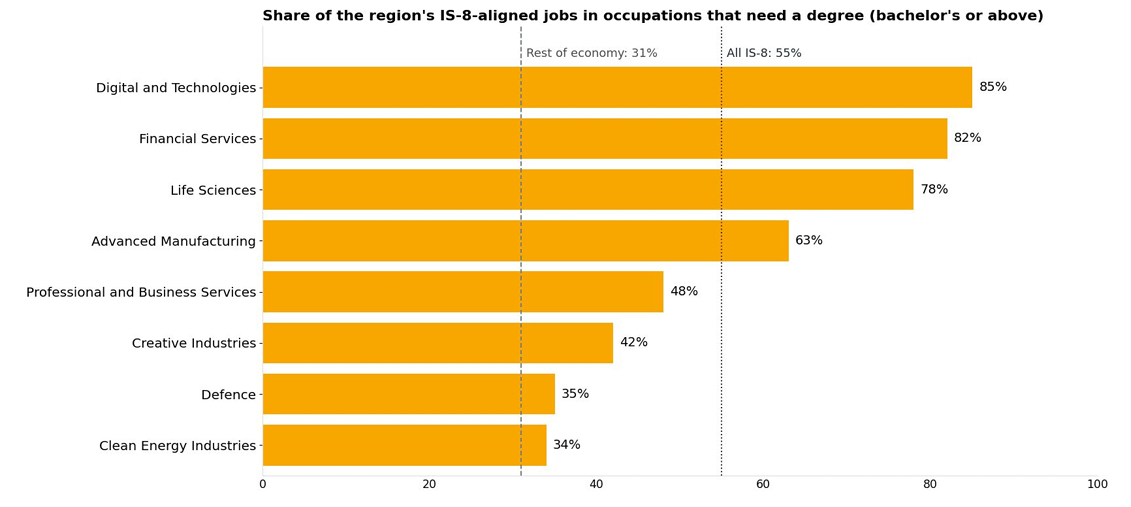
Yet supply is already under pressure. Our analysis estimates annual shortfalls of around 2,160 engineering graduates, 900 computing graduates, 700 education graduates and 300 science graduates on the current path, with several of those gaps widening under greater AI adoption.
Higher education has a central role
The findings point to a need for closer alignment between universities, employers and regional authorities, from expanding provision in shortage areas to embedding AI-complementary skills and creating stronger routes from study into regional employment.
The national report reaches the same conclusion: around 80% of occupations critical to the UK’s Industrial Strategy require degree-level qualifications, making higher education a key part of translating AI potential into economic growth.
Explore the Yorkshire and the Humber deep dive, alongside the national Strategic Role of Higher Education to Deliver the National Industrial Strategy report, for the full analysis of jobs, skills and AI-led growth.