Are global study destinations and degree models being rewritten at the same time?
QS Midweek Brief - February 19, 2026. Malaysia scales towards 260,000 and US institutions accelerate bachelor’s degrees into three years. What do shifting mobility patterns and compressed credentials mean?
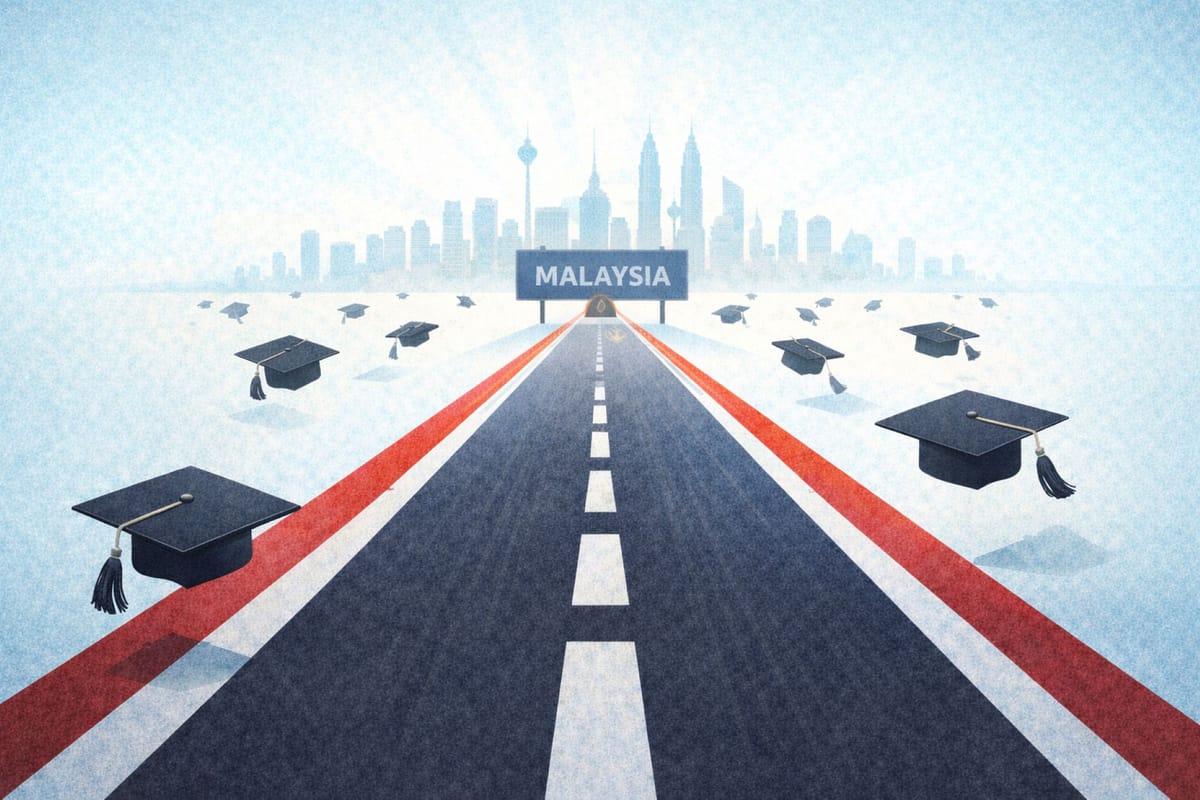
Welcome! I remember first traveling to Malaysia in 2012 as part of a university roadshow. At that time, the country was as a sending destination, but what a difference roughly a decade and a half can make! Now, it’s attracting more international students than ever and it’s set its sights on ever bigger targets.
This week, we explore Malaysia rise and how its sector has responded to these changes. We also look at the increased uptake of 3-year degree programmes in the US, a first for the country.
Stay insightful,
Anton John Crace
Editor in Chief, QS Insights Magazine
QS Quacquarelli Symonds
Malaysia student mobility outlook
By Eugenia Lim
In brief:
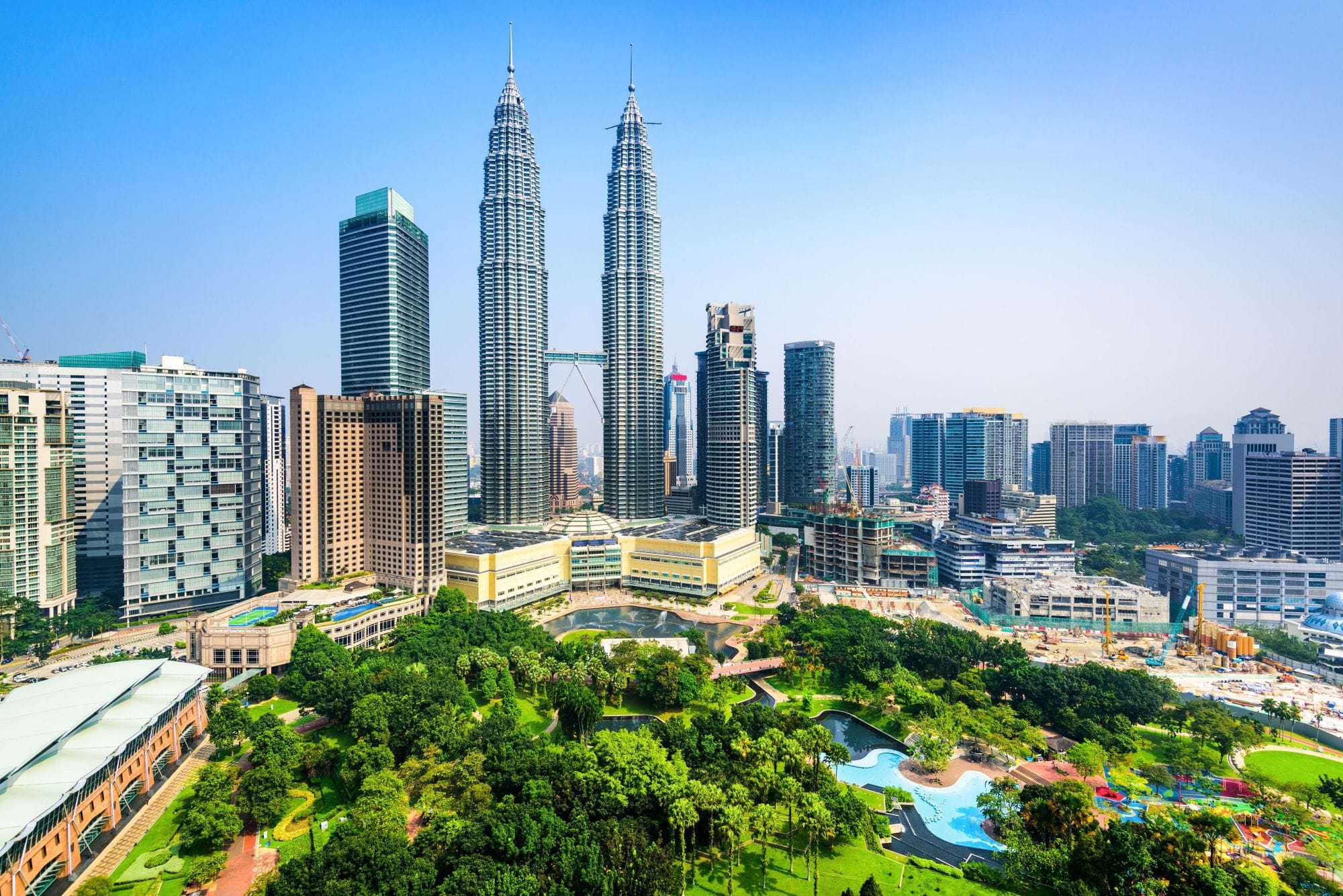
- Malaysia is emerging as a premier study hub, with international enrolments projected to hit 260,000 by 2030, driven by affordability and accessible visa regimes.
- As Western nations tighten borders, students are choosing Malaysia’s multicultural environment and English-led programmes, forcing universities to rapidly expand physical and digital infrastructure.
- To sustain success, institutions must support increasingly diverse student needs while navigating fluctuating government policies on post-graduate work rights and expatriate employment salary thresholds.
Malaysia is set to be a top study destination among international students with one of the fastest-growing international student populations. An average annual growth of 8.5 percent through 2030 is projected in the January 2026 QS Global Student Flows: Malaysia report, outstripping the QS’ estimated global rate of approximately 4 percent.
Meanwhile, international student numbers are projected to reach about 260,000 students by 2030 from 160,000 in 2024. The strong outlook is underpinned by affordability, cultural familiarity and the rapid expansion of Transnational Education, details the report.
Additionally, traditional study destination countries such as the US and UK have been increasingly implementing more restrictive immigration policies, which has set students looking to Malaysia as an accessible alternative.
As such, the Golden Peninsula is benefiting from this displacement effect, offering a comparatively open visa regime and the ability to obtain foreign university degrees.
Affordability & comfort
The projection echoes Adjunct Senior Research Fellow at Monash University Malaysia, Koh Sin Yee’s research in mobility in Malaysia.
In November, Dr Koh wrote an article titled "Regional Student Mobility to Malaysia" in the Singapore-based academic publication ISEAS Perspective, identifying the various trends and issues that have contributed to Malaysia’s emergence as a student mobility destination.
Notably, she raised the affordability of tuition fees in Malaysia. In her report, she wrote that annual tuition fees at US and UK universities cost around US$27,300-47,770 and US$13,650-40,945, respectively, while tuition fees in Malaysia cost around US$1,350-7,000 at public universities and US$2,300-9,500 in private universities.
"The attractiveness of a place like Malaysia is getting higher," she tells QS Insights, highlighting Malaysia's multicultural and multireligious environment as well as the use of English as a medium of instruction as additional draws to prospective international students in the region.
"All of this creates a very comfortable study environment, and also living environment."
Gearing up
Dr Koh raised concerns about the preparedness of Malaysian higher education institutions to cater to the influx of students in the coming years, especially from diverse source countries.
Chinese students currently represent nearly 40 percent of the total of international students in Malaysia, but Southeast and South Asia are projected to remain the fastest-growing source regions, expanding at more than 5 percent annually through 2030, according to the QS Global Student Flows: Malaysia report.
"In terms of the diversity of these student populations, they're coming from wider locations. They may come with different experiences and expectations. Their academic levels may also be quite different," she says.
Dr Koh says universities will have to cater to an increasingly diverse group’s mental health, well-being and learning needs.
Staffing and preparing the necessary infrastructure for a growing cohort of students will also require careful planning and execution.
Those are top of mind for Associate Professor Dr Joaquim Dias Soeiro, Deputy Dean (Internationalisation) at Sunway University. Speaking with QS Insights, he emphasizes that universities are not just crossing their fingers; they are physically expanding to meet the 2030 projections.
Sunway University is undergoing significant expansion for new academic blocks, a performing arts centre as well as a retail space, an effort that has been years in the making.
"The university is expanding because we know there is growth, we have put the ecosystems, facilities and operations in place to welcome the students," he says, "and we know those numbers will come gradually from the international market".
Sunway University targets 30,000 students in 2030, and hopes to up its international student count to 40 percent of its cohort from the current proportion of 30 percent.
One of the ways of ensuring quality education at its institution is by maintaining a healthy student-to-staff ratio, says Dr Soeiro, and Sunway has committed to ensuring there are five staff members for every 100 students.
Dr Soeiro says Sunway University is trying to stay ahead of the numbers and is already in the process of recruiting the staff needed to gear up for more students.
Eugenia is a writer with over 10 years of experience in Singapore's broadcast industry. She is also a producer for Channel NewsAsia and is based in Seoul, South Korea.
The rise of the US’ College-in-3
By Jamaal Abdul-Alim

In brief
- US universities are launching three-year bachelor's degrees to provide students with cheaper tuition and faster pathways into the global workforce.
- Once blocked by accreditors, these programmes focus on rigorous learning outcomes in high-demand fields like computer science, healthcare, and business management.
- By removing elective "filler," this model promotes equity and affordability, allowing international students to complete degrees faster and with significantly less debt.
Before Johnson & Wales University began offering a three-year bachelor’s degree – a credential that takes one less year than the norm for bachelors’ degrees granted in the U.S. – campus leaders checked with a group of constituents who will play a critical role in many of the students’ futures.
"Before we did anything, we sat down and did in-person interviews with the 25 largest employers of our students and explained the degree, what students would experience, the outcome students would have upon graduation,” recalls Richard Wiscott, Provost at Johnson & Wales, a medium-sized nonprofit university that serves about 3,900 students in Providence, Rhode Island in the US Northeast.
"And unanimously, they were in favour of that degree and excited about it because – especially in some of the industries that we serve – they're looking for employees as soon as possible," says Wiscott.
The school offers three-year degrees in four majors: computer science, criminal justice, graphic design and hospitality management – all fields that are on pace to grow in the coming years.
"And so, having someone complete in three years versus four is a benefit to them," says Wiscott.
So goes the three-year bachelor’s creation story for one of a small but growing number of colleges and universities in the US that are offering such degrees, or taking steps towards doing so.
Proponents of the idea point out that the degrees will cost students a quarter less in tuition than four-year degrees and move students into the workforce more quickly.
Although three-year bachelors’ degrees are standard in Europe under the Bologna Process, the three-year bachelor’s degree still represents a "radical" idea stateside, where four-year, 120-credit degrees have largely been codified into state law, proponents say.
"This is really gaining traction in the US. It’s a pretty radical idea," Madeleine F. Green, Executive Director of the College-in-3 Exchange – a group of institutions of higher education that are offering or exploring whether to offer three-year bachelor degrees – tells QS Insights.
Robert M. Zemsky, the University of Pennsylvania Education and Policy Professor who has been pushing for three-year bachelor degrees since 2009, says he has been pleasantly surprised at how many colleges and universities have joined the College-in-3 Exchange, of which he is a co-founder.
"We’re talking to a 100-something institutions,” Professor Zemsky said. "I would have never bet that three years ago. We’ve made"more progress than I could possibly imagine having made. I think we will be at 200 institutions a year from now,” tells Zemsky in a January 2026 interview with QS Insights.
Professor Zemsky says when he first started advocating for the idea over a decade ago, it died after higher education accreditors balked at the idea.
"Accreditors said: ‘No way. A baccalaureate degree is 120 credits. Period," said he says. "But accreditors now see that that is not going anywhere. What is interesting about college-in-three is that these are institutions that are trying to do things differently."
That account is corroborated by the experience of Brigham Young University – Idaho.
"We first thought about these types of degrees in 2009, but our accreditor was not interested in having a conversation at that point in time," recalls Van Christman, Associate Academic Vice President for Curriculum at BYU-Idaho. Christman says the idea "resurfaced" in 2019 and that the school’s accreditor was "more open to the idea."
But it was not a short and easy process.
“We spent about four years working with them on the design of the degrees and doing work to make sure that these would be accepted by employers,” Christman explains. “The main focus for the accreditors was to make sure that we had very solid student learning outcomes.
“We had a list of requirements that we needed to measure as we launched these programmes.”
BYU-Idaho moved all of its online programmes to the three-year format in 2024, Christman says.
“So all new students in online [courses] are signed up in them because that is the only option available,” he continues. He estimates that there are “at least 10,000” of the school’s 42,000 students enrolled in the online programmes.
Asked how the programmes are viewed by international students, Christman describes feedback that shows students are “very excited about having these programmes available to them.”
“They are more attainable than the 120-credit programmes offered before,” he says. “We have not seen any negative. We have students in more than 150 countries. Our largest growth recently has been in countries in Africa.”
Christman says one of the reasons his school began offering three-year bachelor’s degrees to students across the world is because university officials had grown “concerned about the amount of time it would take a student to complete a traditional degree going part time, while also supporting a family, and/or working.”
So BYU-Idaho initially designed its online programmes as “stackable” certificate programmes.
“Students would earn certificates first, interspersed with General Education courses,” Christman explains. “We felt it was unfair to tell a student that they had completed all the learning outcomes for the programme of study and for GE, but they still needed 25-30 credits before we would award them a degree.
“Many of the students are adult learners who know what they want to pursue,” Christman continues. “The free electives were not serving the purpose of exploration. We wanted to make these programmes more equitable to more students across the world.”
The school offers three-year degrees in a variety of subjects. They include: applied business management, software development, applied health, marriage and family studies and professional studies.
The top benefits to students, according to Christman, are being able to complete a bachelor’s degree in a reasonable timeframe, afford an education and thereby achieve equity with other students.
Wiscott, the Provost at Johnson & Wales, which boasts being the first institution in the US approved to offer in-person courses that lead to a three-year degree, expressed similar thoughts.
“The primary benefit to students is the shortened time to completion, which comes along with a lower price tag to complete their college education, all while assuring that the outcomes of the programme that they're enrolled in are the same exact programmatic outcomes that our four-year degree students face,” says Wiscott.
Interest among international students has been “minimal”, but Wiscott stopped short of blaming it on the Trump administration’s more stringent policies regarding visas for students from abroad.
“We had interest from the international student market, and we expect that to grow over time,” says Wiscott. “But this year [2025], the number was minimal just because of things that are happening in society right now.”
Johnson & Wales provided a series of testimonials from students and employers praising the three-year bachelor’s degree. In the student testimonials, which are public, students spoke of how three-year degrees save them money and help them “fast-track” through school and into a career. Employers spoke of similar benefits and called it a “win-win” for students and employers.
In order for the college-in-three movement to make the three-year bachelor’s degree a reality, it’s going to have to produce evidence that three-year-degrees are paying off.
Carleen Vande Zande, Chief Academic Officer at the National Association of Higher Education Systems, is leading the effort to assess three-year bachelor’s degrees among the College-in-3 Exchange members. She says it’s too early to provide evidence on how they’re doing because they’ve only just begun.
“College-in-3 is just starting to collect the data. We only have six or seven institutions with a programme approved by their accreditors and/or states,” Vande Zande said in a written statement to QS Insights. “You will have to check in with us in three more years to see how learning or other outcomes differ for three-year degree students compared to four-year degree students.”
Even without data, Vande Zande says she believes the three-year bachelor’s degree will have much appeal to international students, in part because many foreign universities already have three-year undergraduate degree programmes.
She also says they will appeal because they are linked to programmes in high-demand areas.
There’s also less debt, she says, and “faster completion of the degree, and they can return to their home country.”
Jamaal Abdul-Alim is a veteran education journalist who resides in Washington, D.C. His articles have appeared in Washington Monthly, Education Week and Diverse: Issues in Higher Education. An avid chess player, Jamaal was named “Chess Journalist of the Year” in 2013. Known as “Professor J” among his students at the University of Maryland, College Park, where he teaches journalism, Jamaal is the founding editor of Sneaker Theory, a website that grew out of a project he did to complete a “Sneaker Essentials” course in 2024 at the Fashion Institute of Technology.