
Global Skills Week 2026: Where Higher Education, Industry, and Policy Shape the Future of Talent
On March 25-26, 2026, we’ll unite new analysis and cross-sector perspectives for a data-driven exploration into the global skills landscape, and how leaders from education, business, and government are responding.
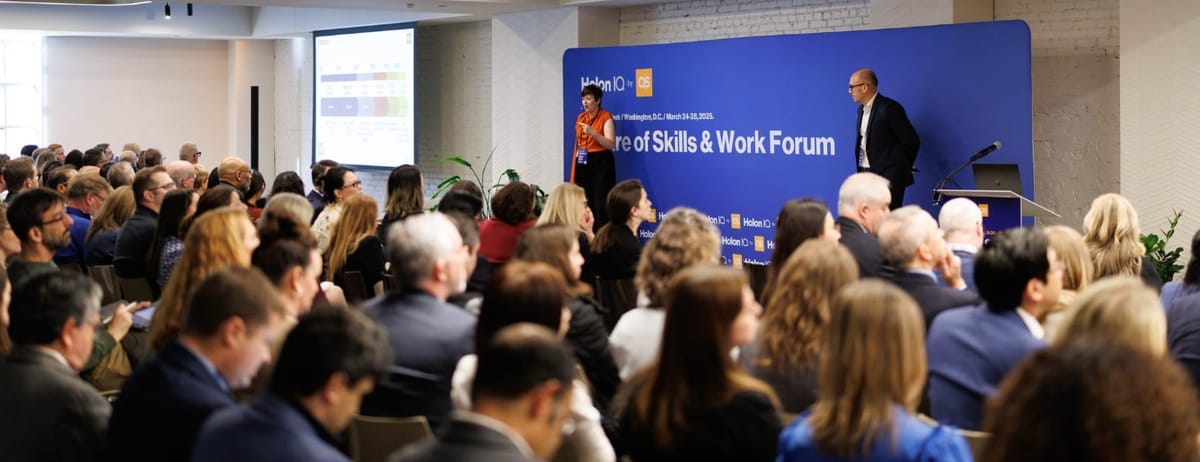
If more than 30% of jobs could be reshaped or replaced by AI by 2030, what does that mean for universities – and for the skills students will need to thrive?
Global Skills Week Returns to Washington, D.C.
On March 25-26, 2026, we’ll unite new analysis and cross-sector perspectives for a data-driven exploration into the global skills landscape, and how leaders from education, business, and government are responding.
Why Attend?
Across two days, you’ll gain:
· Early insight into the fastest-growing global skills, employer demand trends, and the shift toward skills-based hiring
· Practical strategies for redesigning curricula, strengthening talent pipelines, and building future-ready institutions
· Access to expanded programming, including leadership councils, cross-sector workshops, and a new Business School Track
· Opportunities to collaborate across borders on talent mobility, innovation ecosystems, and credentialing models
· A global network of decision-makers shaping the next generation of learning and work
Who Is It For?
Join university presidents, deans and vice-chancellors, business school directors, employers, workforce strategists, policymakers, credentialing bodies, edtech innovators, and global commentators.
The 2025 edition drew attendees from 40+ countries, with particularly strong participation from the US, UK, India, Middle East, and Latin America.
Why Now?
As the global labor market undergoes its most accelerated period of technological disruption since the Industrial Revolution, skills – not credentials – are fast becoming the core currency of economic mobility, employability and institutional resilience. Global Skills Week 2026 unites the people and insights needed to navigate that transformation.
Insights from the Global Skills Week 2025 report show:
· 83% of employers believe graduates lack at least one essential workplace skill.
· Problem-solving, communication, and adaptability remain the biggest skill gaps.
· AI, cybersecurity, digital fluency, and data competencies saw double-digit annual growth in demand.
· Fewer than 15% of working adults in most OECD countries participate in any form of lifelong learning.
· Countries investing in skills-based innovation ecosystems achieve faster productivity gains - even with modest increases in university funding.
For a snapshot of how these trends are playing out in practice, see our overview of the US skills landscape.
What’s New in 2026?
Expanded Program
A two-day main conference (March 25–26) featuring extended sessions, deeper workshops, and broader cross-sector participation.
New Business School Track
Day 2 includes a dedicated track for business schools, exploring:
· How to close the gap between classroom learning and employer needs
· The rising importance of soft skills – adaptability, communication, and intercultural competence
· A high-level breakfast and workshop for business school leaders
As recent analysis shows, business schools that prove employability at the skill level will be best positioned to thrive in the AI economy.
Key Themes
Global Skills Week 2026 tackles the most urgent questions shaping the future of universities and employers. The full 2026 program is still being finalized, with further sessions and expert contributors to be announced.
· AI & Digital Transformation: How should curricula embed AI literacy, automation tools, predictive analytics, and responsible AI practice?
· Skills as the New Global Currency: What happens when hiring shifts from credentials to verified skills?
· Leadership Transformation: Which capabilities will tomorrow’s institutional and corporate leaders need – and how do we develop them? Students are increasingly focused on graduate outcomes – learn how to tell a compelling skills story that resonates with career-focused applicants.
· Green Skills & Sustainability: How quickly must universities build environmental competencies amid rising regulatory demands?
· Credential Innovation: What will stackable, modular, portable learning look like by 2030, and which models will scale?
· Global Talent Mobility: How can institutions create cross-border pathways with consistent, trusted recognition of skills and credentials?
· Curriculum Reinvention for Resilience: Which reforms truly improve employability, student satisfaction, and diversified revenue?
· From Research to Commercial Impact: Where are the strongest opportunities to convert research strength into economic value?
These themes are grounded in QS’s global datasets – rankings, employer insights, graduate outcomes, and predictive labor-market modelling.
We look forward to welcoming you to Washington, D.C. this March.
Looking ahead: the full QS 2026 conference calendar
The institutions moving fastest on innovation are already sketching their travel calendars for next year. If you want first access to speaker updates, partner opportunities, early-bird windows, and exclusive insights, the full list is now live.
Explore the complete QS 2026 conference calendar and be the first to claim your seat at the year’s most influential higher ed gatherings:
https://www.qs.com/conferences/