
The fastest growing jobs are also the most AI augmentable
In the US, AI augmentation propensity correlates to higher wages and higher growth.
For much of the AI era, the debate has centred on displacement. Yet new analysis from QS Labour Market Intelligence suggests a more nuanced reality: occupations with the strongest projected growth through 2030 are also those most likely to be enhanced by AI, rather than replaced by it.
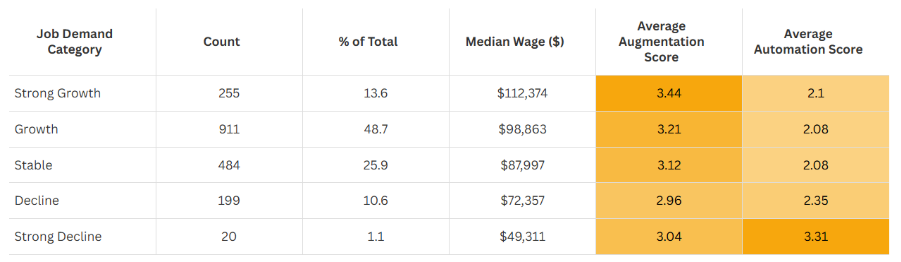
Average AI augmentation and automation scores by employment demand category
What the data tells us
More than 60% of occupations in the QS dataset are projected to grow through 2030. These growing roles consistently record higher AI augmentation scores than occupations in decline, suggesting that AI is often acting as a productivity multiplier rather than a substitute for human labour.
The opposite pattern appears when looking at automation. Occupations experiencing decline have notably higher automation scores, while the strongest-growing roles have some of the lowest.
Importantly, the relationship is not entirely linear. Automation risk alone does not determine whether a role grows or shrinks. Once occupations move beyond a certain automation threshold, factors such as skill scarcity, market demand and the productivity benefits of AI augmentation become more important drivers of growth.
The findings point towards an emerging labour market where value increasingly comes from combining human judgement with AI capability. Roles centred on interpretation, systems thinking, creativity and cross-functional problem solving appear best positioned to benefit.
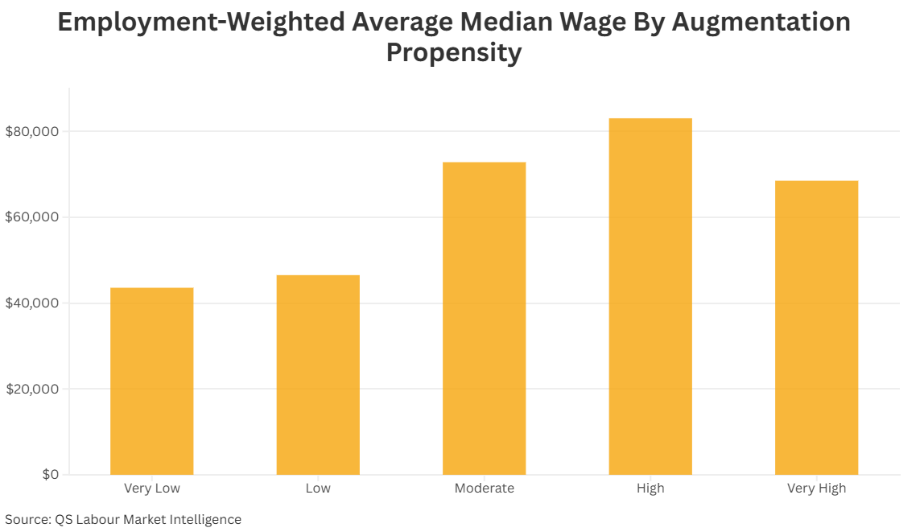
This value is acutely visible when looking at wages. Jobs that have high and very high augmentation potential have higher median wages. The inverse also holds, with highly automatable jobs often paying less.
The bigger picture
AI may not be creating a winner-takes-all labour market. Instead, the evidence suggests that augmentation is becoming a rising tide across much of the economy, helping workers become more productive while sustaining demand for human expertise. The challenge is ensuring people have the skills to take advantage of that shift.
Your next read
- When focusing on vocational training in the UK, we cannot forget the role of higher education. As Andy Burnham pushes for earlier vocational training, it's important to remember that the benefits of higher education go beyond financial ROI.
- How have the Phillippines, Malaysia, Vietnam, Indonesia and Singapore fared in the QS World Future Skills Index 2027?
- Where are employers reporting skills gaps?