How are Canada, Latin America and the US building innovation corridors that last?
QS Midweek Brief - August 19, 2026. How are diaspora bridging the innovation gap? And meet the graduates of Singapore's first arts university.

Welcome! Today we launch the August edition of QS Insights, featuring our second regional supplement for the year: Latin America. This week, we explore the growing innovation corridors occurring between the US, Canada and Latin America. And if you’d like to learn more, there is an entire session on it at the upcoming QS Higher Ed Summit: Americas.
Earlier this month, the QS Insights team was also fortunate enough to be invited to the first-ever graduation for the University of the Arts Singapore, the city-state’s first university of its kind. We bring you the headlines from that ceremony.
Stay insightful,
Anton John Crace
Editor in Chief, QS Insights Magazine
QS Quacquarelli Symonds
How Canada‑LATAM‑US Innovation Corridors are taking shape
By Michelle Zhu

In brief
- A research initiative explores how scientific diasporas can bridge the innovation gap between North and Latin America.
- Short-term funding models currently create structural dependencies, preventing Latin American universities from leading their own research agendas.
- Success requires building permanent institutional machinery, including joint funding, shared governance and strategic use of diaspora networks.
A research project about scientific diasporas — networks of researchers who have left their home countries — has been mapping an innovation corridor built not around factories or supply chains, but around people. Run out of Colombia and backed by Canada's International Development Research Centre (IDRC), it examines how researchers who have fled Venezuela’s prolonged crisis can function as bridges for knowledge exchange, capacity building and innovation across Latin America and the Caribbean.
At the QS Higher Ed Summit: Americas, a panel titled “Building Canada‑LATAM‑US Innovation Corridors” will bring together leaders from Mexico's Universidad Panamericana, Colombia's Universidad Simón Bolívar and Ecuador's Universidad San Francisco de Quito. One of them, Luisa Fernanda Echeverría‑King, Director of International Diplomacy and Scientific Cooperation at Universidad Simón Bolívar, is also a co‑investigator on the IDRC project.
Her diagnosis of what holds these corridors back is straightforward: "The greatest barrier is not the lack of research talent or shared interests, but the absence of sustained institutional mechanisms that enable long‑term collaboration.” Partnerships between Latin America and North America are often project‑based and dependent on short‑term funding, she adds, making it difficult to build lasting research ecosystems.
Echeverría-King’s view reframes the corridor conversation from one about potential to one about design. Rather than asking whether Latin American and North American institutions should collaborate, she points instead to whether they are building the structures that allow collaboration to survive beyond a single grant.
A project that points the way
The IDRC‑funded project offers a concrete example of what a different model can look like. It studies how scientific diasporas can act as strategic bridges, even when home‑country institutions are under severe strain.
The team conducted focus groups with Venezuelan diaspora researchers and analysed engagement strategies across the region, producing policy‑oriented publications and creating collaborative spaces that connect researchers, institutions and diaspora organisations.
For Echeverría-King, the work shows that scientific diasporas are "not only communities abroad but also valuable bridges for knowledge exchange, capacity building and innovation".
The project is significant not just for its findings, but for its architecture: it positions a Latin American institution as a genuine co‑leader; operates across multiple countries and institutions; and treats diaspora networks, which are often an afterthought in innovation corridor discussions, as a strategic asset rather than a loss to be mourned. In a landscape where short‑term, project‑based partnerships remain the norm, the project offers a glimpse of what a more durable model could look like.
The funding architecture problem
Major North American funding programmes reinforce the pattern Echeverría-King describes. Take, for instance, the US National Science Foundation's international initiatives, which typically require a US‑based principal investigator to apply for and manage grants, even when the research takes place primarily in Latin America.
Similarly, Canada's New Frontiers in Research Fund and the Social Sciences and Humanities Research Council's international partnership programmes require that the nominated principal investigator have a primary affiliation with a Canadian institution, meaning that Latin American partners cannot serve as the lead applicant.
The result is a structural dependency that corridor rhetoric tends to gloss over. Latin American researchers can access international networks and equipment, but they rarely lead. Grant budgets, intellectual property arrangements and publication strategies are frequently controlled by the northern institution. Over time, this can suppress the growth of research management capacity in Latin America and limit the ability of local universities to set their own innovation agendas.
Putting numbers on this imbalance is difficult, but findings from the Global Innovation Index offer some guidance: the Latin American and Caribbean region has seen a shrinking share of global R&D from 3% in 2000 to just under 2% in 2024, with Brazil, Argentina and Mexico all recording declines.
While co-authorship between North and South American researchers has risen over the past two decades, recent studies have found that the corresponding funding flows have not become more balanced.
Echeverría‑King’s IDRC‑funded research, published in the journal Frontiers in Research Metrics and Analytics, puts empirical weight behind these concerns. The project’s focus groups with Venezuelan diaspora researchers revealed a community eager to collaborate but forced to rely on informal networks.
One research participant described the existing channels as little more than “former colleagues or friends”. The study’s comparative analysis across Latin America found that even countries with stated policies often lack the instruments to evaluate whether those policies are working. In Colombia, the study found, there is “no institutional or political instrument that evaluates the effectiveness of both science diplomacy and the scientific diaspora”,
The article reinforces her core point: the problem is not a shortage of talent or willingness, but a missing institutional layer. Without joint funding calls, shared governance structures, streamlined visa pathways and long-term partnership agreements, even the most promising collaborations remain isolated and short-lived.
Michelle Zhu is a former correspondent at breaking news desk at The Business Times in Singapore, where she mainly covered corporate announcements including financial earnings, mergers & acquisitions, and board changes. Prior to that, she was part of the editorial team at the Singapore arm of The Edge, a Malaysia-headquartered financial weekly. She holds a Bachelor of Arts in communications and new media from the National University of Singapore.
Art in the Age of AI
By Jocelyn Suarez
In brief
- Singapore’s first arts university celebrates its inaugural commencement, arguing AI makes human-led creativity more vital than ever.
- Educators prioritise "productive struggle" and human judgment to ensure students engage with AI ethically and critically.
- Strategic interdisciplinary collaboration and process-based assessments prepare graduates to lead innovation by asking essential human questions.
As we enter a time increasingly shaped by artificial intelligence, the answer to some of higher education's most pressing questions may lie in an education that has long been considered less practical: the arts.
"Technology can create content, but to make this content deeply meaningful and impactful, we need people to ask the right questions, make sense of complexity, decide what is worth creating, and think completely out of the box," said Desmond Lee, Singapore's Minister for Education, at the inaugural commencement ceremony of the University of the Arts Singapore (UAS).
"That is why an arts education matters more than ever."
Across speeches by university leaders and award recipients, one idea emerged with striking consistency: in an era increasingly shaped by AI, the value of an arts education is not diminishing; it is evolving.
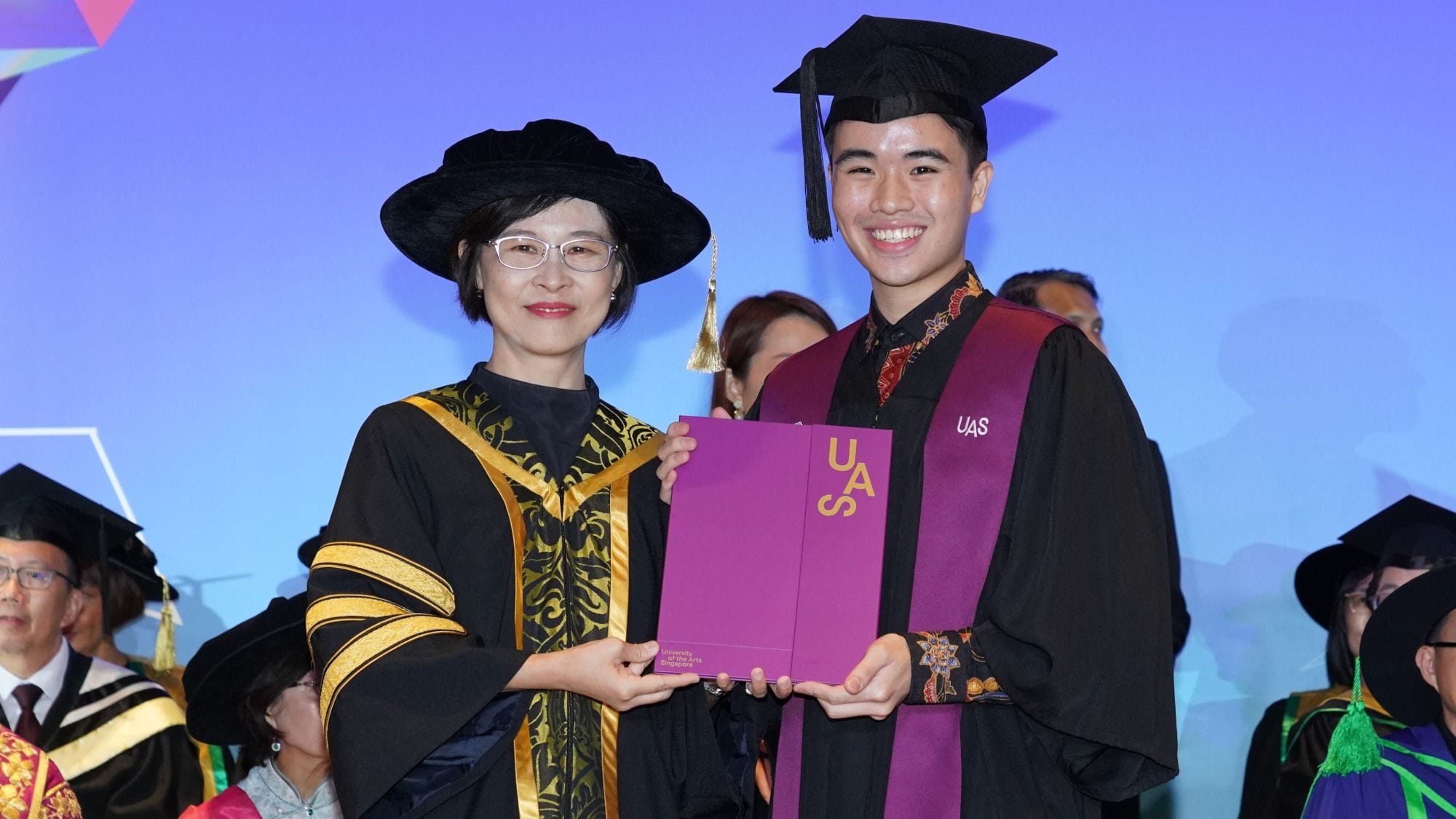
The ceremony marked a milestone for Singapore's higher education landscape. An alliance between LASALLE College of the Arts and the Nanyang Academy of Fine Arts (NAFA), UAS was formed in 2021 as Singapore's first university dedicated to the arts. Held on 7 August, the graduation was the first time a cohort from both LASALLE and NAFA completed their studies under the UAS banner.
Yet beyond celebrating a graduating class, the event became a reflection on the future of higher education itself – and the distinctly human qualities universities must cultivate in an AI-powered world.
Creating meaning in an AI-generated future
Artificial intelligence was never presented as the enemy of creativity. Instead, speakers at UAS’ inaugural commencement framed it as a catalyst for rethinking what makes human creativity valuable.
Professor Kwok Kian Woon, Vice Chancellor of UAS, reminded graduates that while technology has given society unprecedented access to vast volumes of knowledge, "our enduring value lies in our capacity for human judgement and for responsible decision-making". Their education, he said, had given them specialised and interdisciplinary arts training while developing them "as whole persons".
Jocelyn Suarez is Deputy Editor of QS Insights, where she covers ideas, trends and challenges shaping the future of higher education. She is an editor and writer with a decade of experience across digital media, content strategy and journalism. She has also been closely involved with Singapore's literary and arts scene, including through SingLit Station and the Singapore Writers Festival, and has a longstanding interest in the role of arts and culture in society.