What happens when student flexibility becomes a source of stress rather than empowerment?
QS Midweek Brief - Agust 5, 2026. Is too much choice impacting learning outcomes? And what can we learn from Greek TNE?
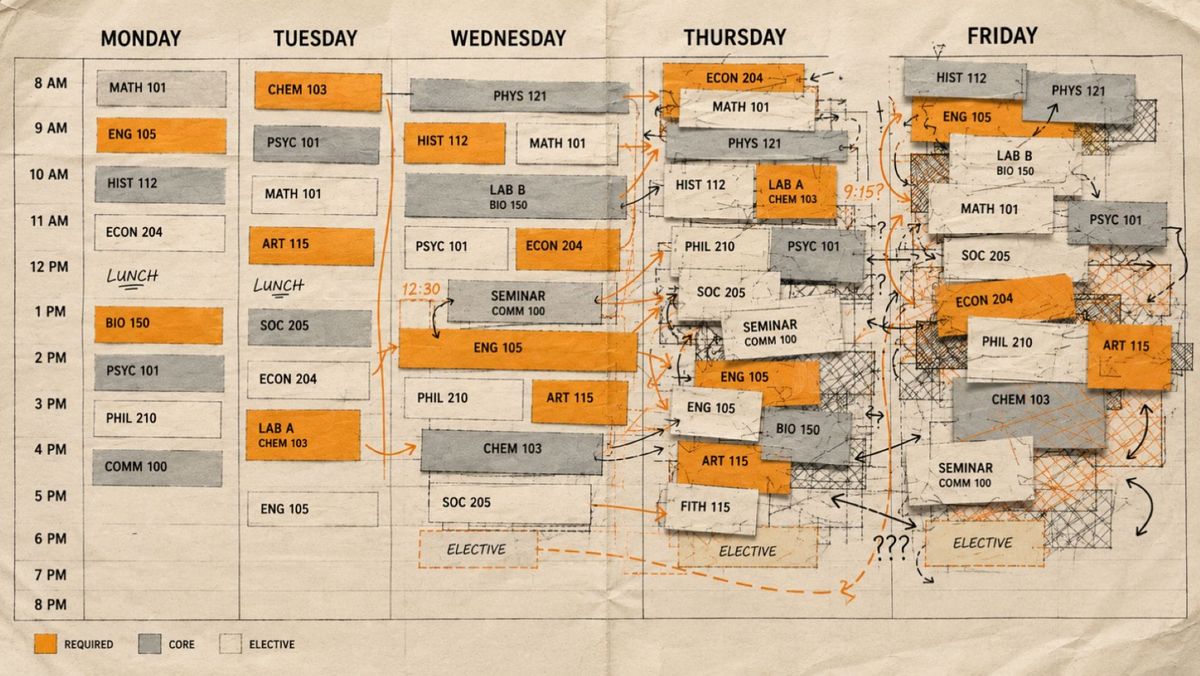
Welcome! It’s becoming a universal experience to look for a film to watch on your streaming service of choice, only to spend half an hour shuffling through options without picking one. Choice overload is so commonplace that some people are using random number generators just to delegate their decision.
When picking something to watch, the worst that can happen is an argument with loved ones. But what if the decision had a significant impact on your future career, earning potential and general happiness?
This week, we explore just that phenomenon. Students now have more choice than ever before, and they might be suffering because of it. We find out how universities are providing guidance to students and getting them accustomed to choice. We also learn more about Greece’s TNE offerings.
Stay insightful,
Anton John Crace
Editor in Chief, QS Insights Magazine
QS Quacquarelli Symonds
The freedom of choice… and the stress that follows
By Chloë Lane

In brief
- Unprecedented student choice is fuelling decision fatigue and regret, potentially undermining the benefits of flexible higher education.
- Over half of graduates regret their study selections, often due to insufficient guidance during their degree.
- Institutions must provide curated pathways and support to help students navigate complex choices and build decision-making confidence.
Flexibility is a major selling point for universities and business schools. Students are encouraged to personalise their higher education experience, with multiple module possibilities, optional placements, study abroad opportunities, internships and volunteering possibilities. The list goes on.
However, behavioural science suggests that, while people value choice, too many options can lead to decision fatigue and regret, as students feel overwhelmed at the opportunity cost of choosing one option over another. This decision fatigue can then lead to worse choices overall as mental energy declines.
This is seemingly backed up by a recent report led by the Higher Education Policy Institute (HEPI), which found that 34 percent of students would have made a different decision about their studies if they could. But whether there’s too much choice for students depends on who you ask…
Why do too many choices feel overwhelming?
“The trend toward greater flexibility and programme customisation can place a cognitive load on students,” says Carlos Rodriguez, Academic Director of the MBA and Global MBA at INCAE Business School in Costa Rica. “While they generally want to tailor their education to their own interests and preferences, too many simultaneous choices can feel overwhelming.”
According to research from the US’ Case Western Reserve University, decision fatigue arises from the demands of repeated decision-making, self-regulation and pressures such as time constraints and stress, all of which reduce an individual's capacity to make effective decisions.
For students, this may be choosing modules for a term, while also trying to decide where to live, what they want to do after higher education, whether they should do a placement, and, if so, where to apply. The cumulative load of these decisions can then result in burnout and overwhelm.
“It shouldn’t be the case, though, if the school distributes key decisions across the length of the programme and gives students the support they need to navigate them as part of a discovery journey,” says Professor Rodriguez.
Whether or not students get overwhelmed by this decision making comes down to the sequence of decisions and support built into the programme, he explains. By navigating decisions progressively, starting small and building towards more complex choices later on, students will develop confidence and trust in their own ability to shape their degree. Yet, schools must also offer guidance.
At INCAE, each programme begins with a common core, tailored to the realities of the Latin American context, and elective courses are progressively introduced partway through, as students begin to discover their interests. The more complex decisions are made later, in the advanced stages of the programme, together with a dedicated support structure and counseling.
Complex decisions can cause excessive fatigue
However, it’s not just the number of decisions students are expected to make, but the complexity of these decisions.
This is backed up by research from Kellogg School of Management, Northwestern University, which shows that extensive choice sets can reduce satisfaction, confidence, and motivation to choose, particularly when options are complex, difficult to compare, or when people are uncertain about their own preferences.
“This doesn’t necessarily mean that universities should reduce choice altogether, and remove flexibility from their programmes, but it does suggest that students might benefit from curated pathways recommendations, and examples from previous students,” says Ceren Sahin, Associate Professor in Marketing at Aalto University School of Business in Finland. “The aim should not be to remove choice, but to make choice navigable.”
She adds that choice can be empowering when it gives people a meaningful sense of agency and fit, but can become overwhelming when people are asked to compare too many options without clear criteria, guidance or a strong sense of their own preferences. Universities can work with students to ensure that’s not the case.
When is choice positive?
Having a lot of options doesn’t have to be a bad thing, and it’s something that students often value – and even expect – when choosing their MBA programme.
“Younger cohorts entering these programmes often express a stronger demand for personalised learning journeys, individual attention, and support in navigating complex career transitions,” says Stefano Pogutz, Director of the full-time MBA program at Italy-based SDA Bocconi School of Management. “Many students arrive in an exploratory phase, with professional trajectories that are still evolving.”
While they’re figuring out the right career path, students expect their university or business school to help them design this journey. This is particularly true for MBA candidates, who are often looking to move from one industry to another. In this context, Pogutz says, flexibility is valuable, but only if it is curated.
At SDA Bocconi, customisation is a distinctive feature of the MBA programme and this is combined with care and attention to students’ individual career aspirations.
However, Pogutz explains that flexibility is not just an academic option that is offered, but also a pedagogical feature.
“Students learn how to define priorities, assess alternatives, make decisions and take responsibility for their choices. Future managers must be able to deal with uncertainty, manage ambiguity and overcome the anxiety that can arise when multiple paths are open at the same time,” he says.
From this perspective, choice gives students the customisation features they crave, while also offering a lesson in consequential decision-making.
Chloë Lane is a gold-standard NCTJ-trained journalist specialising in higher education. A former Content Editor for QS, Chloë has a wide range of experience writing articles for a variety of B2B and B2C publications about topics related to business schools, universities, careers and academic research.
How Greece became a European TNE leader
By Anton John Crace

Europe isn’t the first place that comes to mind as a TNE destination. Most discussions focus on the Middle East, which has had significant success with education cities, or Asia, particularly India as it pursues more partnerships after opening to foreign campuses.
While many might think of Europe as a place that send institutions to form TNE-partnerships, there is at least one place that has become a significant player: Greece. According to the UK-based Higher Education Statistics Agency, Greece is the only European country in the global top 10 for the provision of UK-awarded degrees, at sixth.
Additionally, the number of students choosing to study a UK-degree is Greece continues to rise, with annual growth of almost 16% over five years.
QS Insights sits down with Professor Fotis Papageorgiou, Chief Academic Officer of Metropolitan College Greece and the University of Keele – Greece, to understand why the country has found itself in such a strong position.
QS: Greece sits in a promising position within TNE. Currently, it is sixth choice globally for students seeking a British degree and the country hosts over 34,200 students for that purpose. What are the factors influencing this?
Professor Fotis Papageorgiou: Several factors converge. Greece offers a UK-awarded degree delivered within the EU, which since Brexit carries real weight for EU and international students who want UK qualifications without the immigration friction associated with studying in the UK.
The cost base is considerably lower than the UK, allowing students to remain close to home while accessing labour-market-relevant programmes linked to local employer needs.
Programmes are validated and quality-assured by the awarding UK institutions, with recognition pathways domestically and international portability. Many are delivered in Greek, widening access while demonstrating strong institutional trust and robust oversight of teaching, assessment and outcomes.
There is also the lifestyle and safety dimension, which matters more to families than is usually acknowledged. And there is institutional maturity: Greece did not arrive at TNE recently. Providers here have spent three decades building the partnerships, staff capacity, employer links, regulatory relationships and multi-campus delivery capacity. Metropolitan College, for example, operates eight campuses across Greece, a scale that allows the model to grow credibly rather than opportunistically.
QS: It’s noteworthy that Greece is the only European country within the top 10 destinations for UK-led TNE, with Germany at 11. All other destinations sit within the Arab region and the Asia Pacific. Is this a challenge or opportunity and why?
FP: Decisively an opportunity, though it carries a responsibility. Being the sole European destination of that scale means Greece is not competing for the same students as the Gulf or East Asian hubs; it is serving a distinct constituency — students who want a UK degree within a European academic environment, with the mobility, qualification portability and cultural proximity that implies.
It also reflects mature local delivery capacity, strong family demand for international education closer to home, and a cost-value proposition strengthened by Brexit and visa pressures. Germany, where I have worked for years, at eleventh position confirms the demand exists across Europe but has not yet been met at scale elsewhere.
The challenge is simply not to mistake a head start for a moat. The position has to be earned continuously through programme quality and partner confidence.
QS: In a recent Advisory Board meeting hosted by Metropolitan University, the “perfect storm” of Brexit and strict visa restrictions was a noted opportunity for other countries. Considering the pressures on research and research funding, how do you see the TNE model evolving?
FP: The Brexit-and-visa "perfect storm" opened the door; what keeps it open is whether TNE can mature beyond teaching delivery into genuine academic partnership.
The first-generation TNE model was essentially a validated teaching export. The pressures now on UK research funding accelerate the next phase, because UK institutions increasingly need international partners who can support research activity, doctoral training and exchanges, applied innovation, employer-linked projects and regional talent pipelines, not just undergraduate teaching. That is where the model is heading — branch campuses and partnerships that share research capacity, student experience, digital infrastructure and workforce-development agendas, not just curricula.
Greece is well placed for this: it is an EU member state embedded in European research and innovation frameworks, offering UK institutions a stable European environment for collaboration. A serious Greek partner can offer a UK university European connectivity, regional stability and scalable academic infrastructure. That reframes TNE from a revenue arrangement into a strategic one.
QS: Do you envision a unique Greek-style model to TNE, or something that is transferable to other destinations as well?
FP: Both, in sequence. There are elements genuinely specific to Greece: the legal framework, which created a regulated pathway for branches of foreign universities; the depth of the existing provider base; the multi-university platform experience already developed by established local institutions like Metropolitan College; Greece’s regional position between Europe, the Balkans, the Eastern Mediterranean and the Middle East; and the cultural and historical resonance of studying in Greece. These are not easily copied.
But the underlying principle: a regulated, quality-assured EU-based host environment delivering UK degrees through scalable local infrastructure, strong student support, employer relevance and emerging research capacity, is entirely transferable, and other European states may well adopt versions of it. I would rather Greece be remembered as the country that proved the model could work at scale than as the one that tried to keep it proprietary. The lasting advantage comes from being first and best, not from being the only one.
QS: In the Advisory meeting, Ambassador Makis Pantzopoulos suggested that regional instability provides a unique opportunity for Greece to serve as a “safe haven” of knowledge. How do you see this geopolitical context influencing how TNE continues to develop?
FP: Greece's stability relative to parts of its wider neighbourhood is a real asset — for students and families from the Eastern Mediterranean, the Middle East, and beyond, the combination of a UK degree and a stable and safe EU-based environment is genuinely scarce.
Its geography also matters: Greece sits between Europe, the Balkans, the Eastern Mediterranean and the Middle East, making it both a safe destination and a regional bridge for talent, universities and employers.
But a safe haven is only valuable if there is something of substance within it. The geopolitical advantage gives Greece the opening; the academic offer has to justify the journey. Used well, this positions Greece as a deliberate first choice — a place where a student from a region experiencing instability can pursue a UK degree, in an academically robust environment, with European quality assurance, cultural proximity and regional relevance, without compromise on quality or security.
Anton John Crace is Editor in Chief of QS Insights. He has been writing on the international higher ed sector for over a decade. His recognitions include the Universities Australia Higher Education Journalist of the Year at the National Press Club of Australia, and the International Education Association of Australia award for Excellence in Professional Commentary.