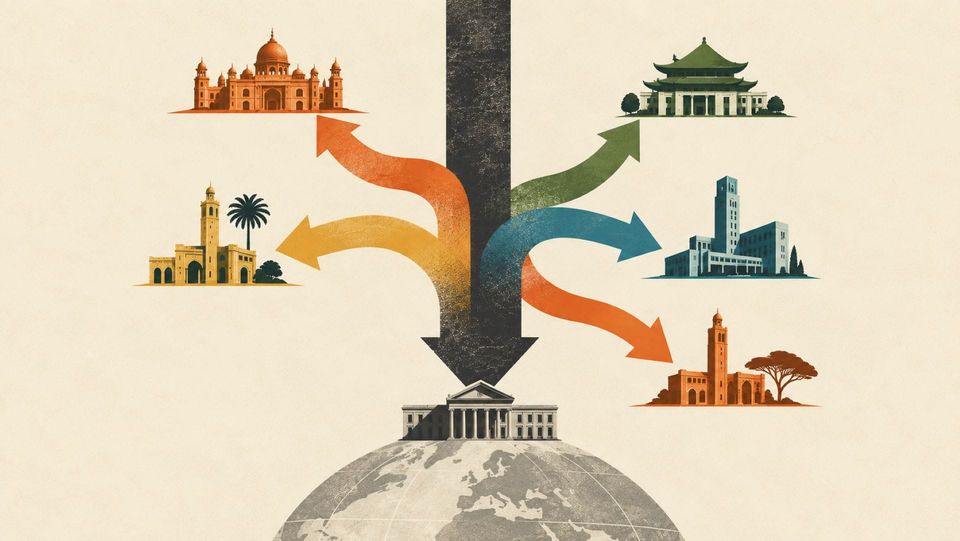
What is the difference between information and knowledge in an AI-powered classroom?
QS Midweek Brief - June 10, 2026. What do business school educators think about AI in education? And is Ireland becoming a victim of its own success?
Welcome! This week’s newsletters comes hot off the back of the 2026 QS EduData Summit. Keep an eye out on next week’s QS Insights Magazine for coverage, but key talking points from the summit focussed on human-centrism, context and a shift in knowledge transfer.
We continue that last point in our first story this week, answering the value question in AI-powered knowledge transfer. In our second piece, we continue our trip through Europe in anticipation of the QS Higher Ed Summit: Europe later this month, this week visiting Ireland.
Stay insightful,
Anton John Crace
Editor in Chief, QS Insights Magazine
QS Quacquarelli Symonds
Will AI replace the knowledge part of higher education?
By Chloë Lane
In brief
- AI makes information accessible, forcing universities to redefine their value beyond traditional classroom knowledge transfer.
- AI handles information acquisition, but humans provide the critical judgment, context and ethical reasoning defining true knowledge.
- AI makes information accessible, forcing universities to redefine their value beyond traditional classroom knowledge transfer.
AI handles information acquisition, but humans provide the critical judgment, context and ethical reasoning defining true knowledge.
Institutions must prioritise experiential learning and human networks over static content delivery to provide clear student value.
Since the introduction of AI, knowledge transfer is more readily accessible than ever, yet the cost of higher education is still rising.
A well-prompted AI model can probably explain graduate material more patiently than a lecturer at four in the afternoon, admits Michael Erkens, Rector Magnificus at Nyenrode Business University in the Netherlands.
“If the goal is to transmit a concept clearly, a well-prompted AI tutor is competitive with an average lecture and available at any hour,” he says. “Contact time has become too expensive to spend on information transfer. Students can get the same thing on their phone, often more patiently.”
Why, then, should students pay for higher education when they can get the content for free?
Has knowledge always been cheap?
“Free content is not a new concept. Libraries, open courseware, YouTube, MOOCs (Massive Open Online Courses): each was supposed to end the university, and none did. The reason is simple. Students do not pay for content. They pay for what surrounds it,” he says.
The role of a professor, he explains, is to use contact time for what only works with people in a room: judgment under pressure, ethical reasoning on dilemmas with no clean answer and the skill of working with AI rather than against it.
“The old-style lecture, one person at the front reading slides, was already in trouble well before ChatGPT. AI just makes it harder to ignore,” remarks Dr Erkens.
Besides, it’s the bridges universities build that AI can’t replace – between theory and practice, between disciplines that do not normally talk to each other, between generations of leadership, and between business and society more broadly. “Those bridges are not built through content delivery. They are built through people who have crossed them meeting people who are about to,” he says.
At Nyenrode, then, AI is not a threat; just an additional way to acquire knowledge. Students will use AI to explore materials before class to allow them to prepare for case discussions at a depth that was not practical five years ago. Professors teach students how to use AI well, and how to spot when it is wrong. AI models are used by faculty to generate richer teaching materials, to simulate counterparties in negotiation exercises, and in research.
AI can help acquire knowledge, but, as Dr Erkens puts it, “it’s not the holy grail”. It cannot cultivate judgment. The capacity to apply knowledge, know when it has broken down and what to do, is built through dialogue, critique and reflection inside a community of scholars and peers.
“Class time becomes the place for case discussion, live challenge and the Socratic pressure that is uncomfortable in the way good teaching should be. The lecturer shifts from information source to designer of experience: selecting the cases, framing the stakes, pressure-testing student reasoning. A more interesting role for faculty, and a more valuable hour for students,” Dr Erkens says.
Higher education is not about being about to recite facts and formulas, agrees Baback Yazdani, Executive Dean of the UK’s Nottingham Business School. “You can do that by finding a good reference book.”
Nottingham Business School partners with major international companies such as Microsoft and Google, as well as SMEs, to understand what is needed from the graduates of the future when it comes to AI. Each of these companies has reiterated to Yazdani the importance of critical thinking, problem solving and higher levels of human intelligence.
With this in mind, AI will “absolutely not” replace the knowledge function of higher education, he says. In fact, it’s needed more than ever before.
“[Higher education] is about expanding your thought process and learning how to be creative in a given area,” he explains. “It’s about becoming open to new ideas and personal, scientific, cultural and social growth.”
The shifting value of education
Perhaps it’s not that AI is replacing knowledge at all, but more we are misusing the word ‘knowledge’. According to Matt Offord CMBE, Senior Lecturer in Experiential Leadership Education at Adam Smith Business School in the UK, people tend to use words like data, information and knowledge interchangeably when the reality is that they are all different.
Data is simply observable differences in the world, while information is data that has been organised and processed. Knowledge, however, needs to be true, actionable and contextualised.
The acquisition of information does not constitute knowledge, he explains, so it would be more accurate to say AI can replace – to some extent – traditional information acquisition.
“Only humans can create knowledge because only humans know what is true, understand context and how knowledge can be used for action,” he says. “In my classes, I point this out to students. I tell them to use AI for the mundane organisation and reorganisation of data, but to use their own wonderful, sophisticated brains to create knowledge.”
While it may appear that AI can replace traditional knowledge acquisition, this is very different to learning. The value of universities, then, is to teach students how to learn, and how to think critically. “How to elevate their thinking beyond anything that a machine is capable of,” says Dr Offord.
“The broader trend is a transition from ‘what you know’ to ‘how you think’,” says Himanshu Rai, Director of the Indian Institute of Management, Indore (IIM Indore).
Ten years ago, higher education institutions focused heavily on delivering content through lectures, emphasising memorisation and standardised assessments. Today, AI can handle much of this information work, shifting the value of education towards higher-order skills.
“Education is becoming more experiential, project-based and adaptive, moving away from static knowledge delivery towards active intellectual development,” he says.
Several of IIM Indore’s courses already include simulations and role-plays, where students are encouraged to enhance their creativity using AI. Going forward the hope is to evolve lectures into interactive sessions focused on debate, problem-solving, and collaboration.
Choosing between AI and higher education
For those trying to choose between self-learning with AI and a degree, Dr Rai says it largely depends on the individual. Students who possess strong self-discipline, clear goals and the ability to think critically about information will find AI-based learning highly effective. Whereas those who struggle with consistency and direction will find that higher education provides structure, accountability and access to mentorship – all of which will help them progress.
On top of this, learners will gain recognised credentials and a valuable social network. “A balanced approach is most effective,” advises Dr Rai, “using AI as a powerful tool to enhance learning while benefiting from the structure and credibility of formal education.”
INSEAD Professor of Technology and Operations Management and Dean of Executive Education, Sameer Hasija, says that one of higher education’s roles now is to help students learn how to reinvent themselves and their organisations.
As part of a forecasting exercise, executive education participants at French-based INSEAD are given access to all the information they might need to make a specific business decision, but they are deliberately left with uncertainty. “It was not a decision that can be codified. It required human judgment,” he says. “The information that helped them calibrate the uncertainty was provided.”
As these exercises show, human judgement is still needed, even if knowledge can be sought through AI.
Defining the purpose of higher education
In 2026, AI is higher education’s most important competitor. It forces higher education professionals to confront the value of a degree. Knowledge acquisition alone is no longer a unique selling proposition, and would-be students are starting to recognise this.
Universities and business schools must offer something that students cannot easily access on their own. For some, this is structure and discipline. For others, it’s a strong alumni network, work experience, or critical thinking skills.
The pressure is building. More than ever, students are weighing up the return on investment, and higher education institutions need to be clear what this is.
Chloë Lane is a gold-standard NCTJ-trained journalist specialising in higher education. A former Content Editor for QS, Chloë has a wide range of experience writing articles for a variety of B2B and B2C publications about topics related to business schools, universities, careers and academic research.
Ireland’s growing popularity is testing the limits of its success
By Seb Murray

In brief
- Ireland emerges as a global education winner, attracting record numbers of American and international students.
- Unique EU access and English-language teaching drive growth, but a severe housing crisis threatens the student experience.
- Sustaining success requires urgent infrastructure investment and closing a €300 million funding gap to remain competitive globally.
American students are turning up on Irish campuses in growing numbers. At Trinity College Dublin, acceptances from US graduate students rose 40 percent this year, according to The Irish Times. At the University of Galway, demand from the US jumped 50 percent.
Part of the shift is political: some American students say they have become uneasy about the increasingly polarised atmosphere on US campuses. Others have been pushed away by high tuition fees.
Ireland, meanwhile, has found itself in an unusually strong position: an English-speaking country inside the European Union, with globally recognised universities and public finances boosted by corporation tax windfalls from large multinationals.
Right now, Ireland is both rich and attractive. In the latest QS World University Rankings for Europe, 87.5 percent of the country’s ranked universities moved up – the strongest performance of any European country.
“With the problems facing the traditional big four destination countries, Ireland is in a strong position,” says Andrew Crisp, a London-based higher education consultant. The big four – the US, UK, Canada and Australia – have all tightened visa rules or faced rising political and affordability pressures in recent years.
The uplift in Irish university rankings is part of a broader reshaping of global student flows. Ireland is increasingly benefiting from students and researchers looking for an English-speaking base inside the EU.
Crisp points to Ireland’s cultural appeal – openness, safety and reputation as a welcoming place.
Laurent Muzellec, Dean of Trinity Business School in the Irish capital Dublin, says its position as the only English-speaking country in the EU gives it a “distinctive advantage” in attracting globally mobile students, academics and research partnerships.
“Ireland’s higher education sector has several structural strengths in an international context,” he adds.
But the strain is starting to show. International student enrolments in Irish higher education climbed above 44,000 last year, a record high and the fourth consecutive annual increase, driven largely by rising demand from India and the US.
Housing shortages and rising living costs, especially, are becoming harder to separate from the international student experience.
An accommodation crisis is particularly acute in Dublin, but the problem stretches well beyond the capital. Ireland’s main university cities are facing a shortfall of almost 39,000 student beds.
Crisp says: “Scale may be an issue – smaller countries sometimes struggle to be heard in the highly competitive international education market.”
But there is plenty in the country’s favour. Ireland’s higher education system has become closely tied to the country’s broader economic model.
For decades, Ireland has used low corporate taxes, EU market access and a highly educated workforce to attract foreign investment, particularly from US technology and pharmaceutical companies.
Universities have become a central part of that pitch.
“Ireland is now one of the most globalised economies in the world,” says Jim Power, an Irish economist. Exports and foreign direct investment are “an integral driver of economic activity”, he says, while the quality of the workforce remains one of Ireland’s most important economic advantages.
Among OECD mostly-rich countries, Power says Ireland has the second-highest proportion of adults aged 25 to 64 with a college degree, behind only Canada.
Work by Séamus McGuinness, a research professor at the Economic and Social Research Institute at Trinity College Dublin, suggests the system is functioning relatively well.
“Our research shows that Irish employees utilise high level general skills and advanced digital skills at a rate that exceeds most other EU countries,” he says, adding that there is “little evidence” of sustained skill shortages or skills gaps.
Federica Pazzaglia, Director of UCD Michael Smurfit Graduate Business School, says Ireland’s success “did not happen by chance”, pointing to long-term coordination between the state, universities and multinational employers.
“These firms are not simply drawn by fiscal policy but by the quality of graduates, the strength of connections with research institutions, and a talent that has proven itself over time,” Pazzaglia says.
Ireland’s universities, then, are no longer operating simply as places of scholarship. They increasingly underpin the country’s economic model, feeding employers and reinforcing Ireland’s position as an English-speaking gateway to the European single market.
The same forces helping drive Ireland’s economic growth, however, are also adding pressure to infrastructure, creating strains that universities cannot ignore.
Still, Ireland offers a combination that has become increasingly attractive: English-language education inside the EU, strong ties to global employers and a job market that, until fairly recently, was in strong health.
Seb Murray is a journalist and editor who writes often for the Financial Times and has written for The Times, The Guardian, The Economist, The Evening Standard and BBC Worklife. He focuses on higher education and global business. He also produces a wide range of content for a range of corporate and academic institutions. Seb is also a recognised expert on higher education and speaks at international conferences.