
🔬 Evidence, education, and EdTech: a new era of outcomes accountability.
Inside the studies, labs, and partnerships shifting how leading institutions compete. Read the EdTech Ecosystem Hubs Report. Innovation events to note in 2026.

Hello 👋
The power moves in education recently are noteworthy: leading institutions and partners are seeking evidence that the technology solutions they've invested in are improving learning. Yet, it looks less like a research exercise than a shift in how the sector is competing.
Eedi and DeepMind have begun a 1,525-student randomised study across ten UK secondary schools to isolate how much of an AI tutor's effect comes from pedagogy versus personalization, with math results due summer 2026. NYU and SUNY have launched a joint Design Lab to test which higher education programs measurably shape student outcomes. CodePath and Anthropic have set up a 15-month study across thousands of community college, state school, and HBCU students to see who benefits, who over-relies, and which design choices matter. The OECD's Digital Education Outlook 2026 reinforces the pattern, showing general-purpose AI tools can lift task performance without producing real learning, while purpose-built tools tend to show measurable gains.
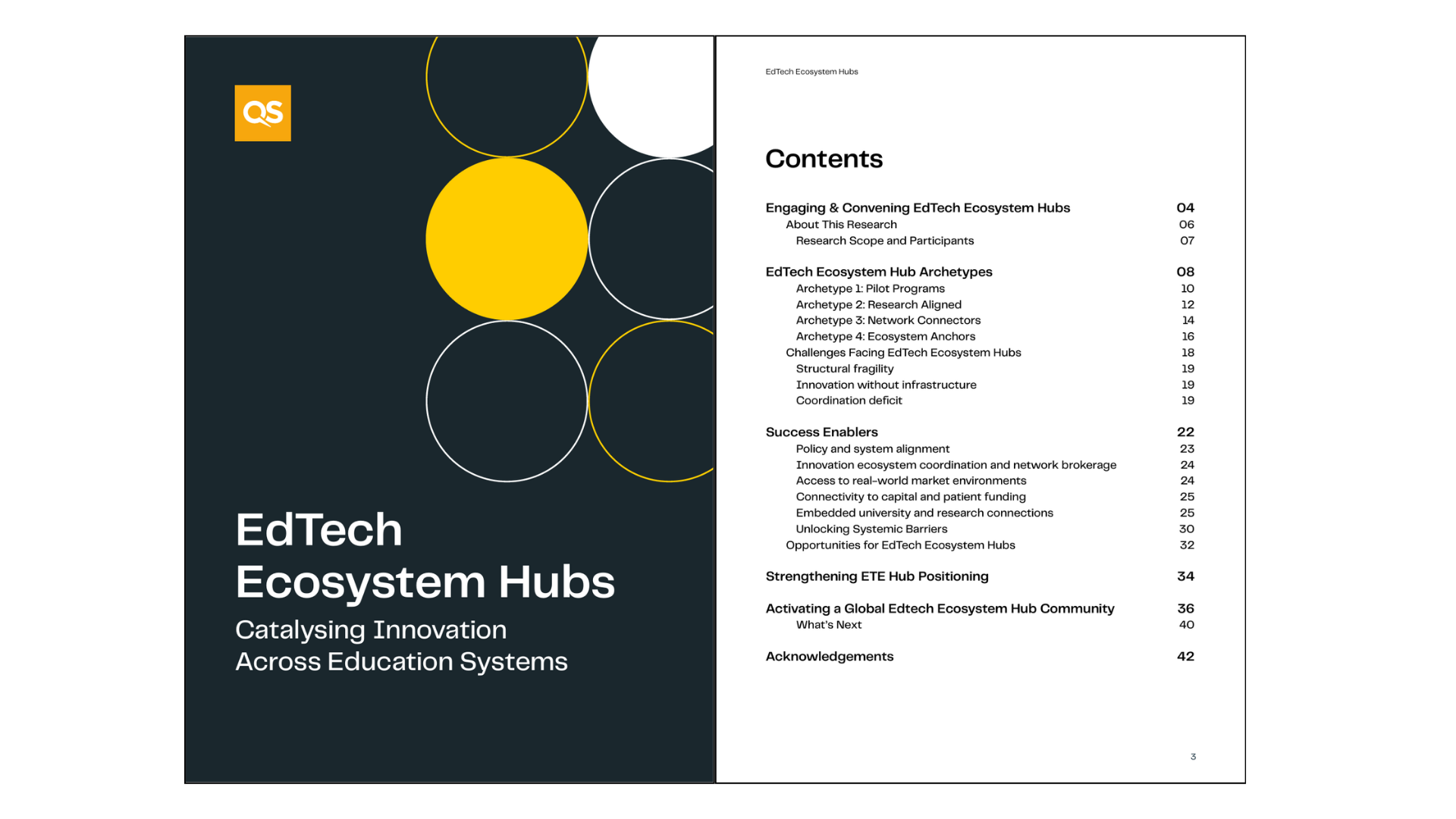
Evidence of outcomes is starting to look like what could separate serious players from the rest, and what procurement, partnerships, and capital may increasingly sort by. The latest Insights article on EdTech Ecosystem Hubs and full report shows an industry that isn’t evolving to support more technology, but rather a stronger system of innovation, one that supports and scales the solutions and practices that demonstrate outcomes.
Read the webnote and the full report here.
👉 For more insights on innovation and technology in the education market, go to the QS Analytics Platform if you are customer or request a demo to learn more.
📍 Upcoming Education Innovation Events
| Event | Date | Action |
|---|---|---|
| 🏆 EdTechX Awards 2026, London | Apply by 22 May ⏰ | Apply now |
| 🦾 Webinar: Micro-credentials for skills & lifelong learning | 26 May | Register |
| 🚀 London EdTech Week 2026 | 15–19 June | Register free |
| 🎓 QS Higher Ed Summit: Europe 2026 | 24–25 June | Register |
| 🗽 25th Annual 'Back to School' Summit, NYC | 15-17 Sept | Register |
| 📅 QS Reimagine Education 2026, London | 7–8 Dec | Save the date |
| 🗓️ 2026 Innovation Webinar Series | On-demand + live | Browse all |
⭐ AI & Digital Innovation Spotlight
֎ Stanford University has merged its artificial intelligence and data science efforts into a single institute retaining the 'Stanford Institute for Human-Centered Artificial Intelligence' (HAI) name.
🧩 Udemy, an online learning platform, has expanded its AI role-play capabilities to provide more immersive and skills-based learning experiences for its users and help learners build real-world professional skills through immersive practice scenarios.
🖥️ Microsoft and Seoul National University have launched a free Korean AI literacy learning and certification program for educators and non-profit workers. The program aims to strengthen AI capabilities and provide credible certification opportunities.
🤝 Policy & Partnerships
🖥️ Kazakhstan has partnered with OpenAI to introduce AI into its education system with 165,000 ChatGPT Edu licenses distributed.
🧑🏭 The Seoul Metropolitan Government is revamping its digital education system to focus on practical AI training for citizens.
🏥 China issued the 'Action Plan for "Artificial Intelligence + Education"', seeking to incorporate AI into teacher qualification exams and certification to improve teaching quality and address uneven resource distribution.
💪 Power Moves & Funding
֎ The University of Southern California received a $200M donation to expand AI research and support interdisciplinary programs.
🧠 The University of Guelph received $51M to expand business education facilities, launch work-integrated learning programs, and strengthen leadership and workforce development.
💼 Johns Hopkins Carey Business School received $50M to support entrepreneurship funding, faculty professorships, industry partnerships, and business-of-health education initiatives.
🌐 Herd Security, a cybersecurity training provider, raised $3M to expand its AI-powered cybersecurity training platform, supporting workforce training against AI-driven threats.