When academia laughs at itself, what problems become easier to name out loud?
QS Midweek Brief - May 6, 2026. What can a game making light of academia tell us about actual challenges? And how do we create digital transformation as well as use data that matters?
Welcome! Universities can often take themselves very seriously, and for good reason. Not only are they responsible for shaping the minds of future generations, but they’re also expected to produce research, help industry, and reach out to the community, while also balancing budgets and financial pressures, among other things. For all their seriousness, however, they’re also places that are both quite silly at times and self-aware enough to understand their own contradictions.
This week, we meet someone who has taken those contradictions and created a board game lampooning academic life. While humorous, it also seeks to address more serious concerns within academia. We also carry two pieces, one reflecting on the implementation of technology on campus and the second on understanding what data readiness really means.
Stay insightful,
Anton John Crace
Editor in Chief, QS Insights Magazine
QS Quacquarelli Symonds

Play or perish: Satire as an antidote for academic stress
By Claudia Civinini
In brief
- "Publish or Perish," a satirical board game, uses humour to tackle the pressures of modern academia.
- Players navigate peer reviews, "academic trash talk" and budget cuts to secure citations while exposing systemic flaws.
- The game acts as a therapeutic tool, sparking honest dialogue about mental health and academia's inherent unfairness.
A theory is like a reality TV show: dramatic, sometimes morally questionable, and undeniably captivating to its devoted fans. Or: introducing your new hypothesis is like launching a conspiracy theory. You’ll have followers, detractors and a lot of people demanding proof.
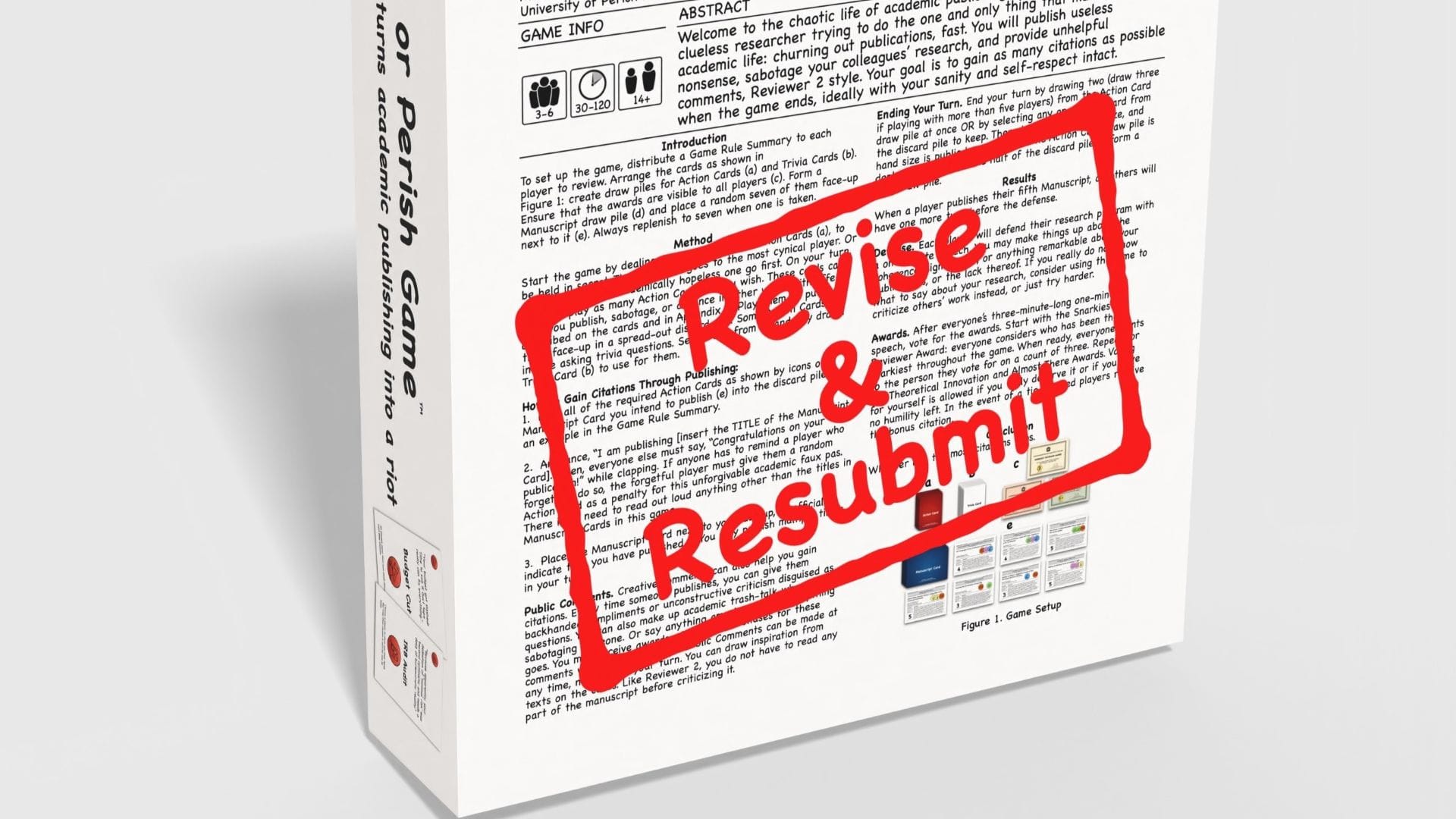
These are not humorous aphorisms for academics, but ‘theory’ cards from the Publish or Perish board game created by Dr Max Hui Bai.
If you pair these theory cards with a ‘writing’ card and avoid being sabotaged by a ‘budget cut’ or a ‘mishap’ card, you could publish a paper titled “Pointless Meetings: Embracing Inefficiency for Those Who Have Given Up” in the journal Proceedings of Pointless Papers, and get five citations.
Citations are, obviously, the goal. Sounds familiar?
Dr Bai, a social psychologist now Director of the Publish or Perish Game and of the Political Belief Lab, an independent research lab, worried that some academics would consider his satirical board game a form of professional self-sabotage.
But academics and the general public liked it – it was another group, he says, that wasn’t too impressed: professional board game designers and board game enthusiasts.
“They want things that are mechanically balanced, like the Euro board games,” he says.
Euro Games, he explains, are about computation, with minimal interaction between players – such as in chess – and they are fair.
American games, on the other hand, are party games – for example, Monopoly or, especially resonant in this case, Cards Against Humanity and Exploding Kittens. They still entail some strategy, but user interaction and luck play a much bigger role; as such, they perhaps offer a more fitting metaphor for work life – or life in general.
“The game resonated with a lot more people than I anticipated,” Dr Bai says.
“It picked up on the insider perspective, looking at our own lives, looking at complaints we have every day: about the ridiculous parts of the peer review process, the bureaucracy of the university system, all of these things that actually resonate with our lives.”
Audits and haunted houses
The purpose of Publish or Perish is to publish manuscripts and accumulate citations. Action cards allow players to progress or sabotage others – for example, with ‘mishap’ cards with snarky comments (“Your groundbreaking concept? Yeah, it was groundbreaking… in 1985.”), citation errors, Institutional Review Boards audits, and others.
Humorous nods to real-life issues abound in the game. ‘Someone’s paper just got retracted – their citations of your work went down with it’, warns a ‘citation error’ card, while a ‘perseverance’ card titled ‘denial of job market reality’ reads ‘blissfully ignoring job prospects, you press on with unwavering determination.’
Despite being branded as ‘useless nonsense’, the manuscripts, each complete with an abstract, an author, a journal title and a department, are laugh-out-loud satirical snippets. Procrastination is a very frequent topic. Unproductive meetings, predatory journals and echo chambers also make an appearance, among many other pressing questions such as blood-type diets for vampires, zombie fitness routines, or whether haunted houses are just a case of bad plumbing.
Throughout the game, players are encouraged to interact: by complimenting each other when publishing (clapping is compulsory), defending one’s research, and, most importantly, giving each other comments and using ‘academic trash talk’ – backhanded compliments or unconstructive criticism disguised as questions are explicitly encouraged in the instructions. An impressive range of trivia questions offers another occasion to interact, and to reflect on the beauty of the pursuit of knowledge.
“My game is satirical, but I don’t want to portray academic life negatively,” Dr Bai explains.
“There are reasons why people stay in it: the intellectual pursuit, the discovery of knowledge… I wanted to highlight that too.”
Taking on a new persona
Because the game emphasises communication, Dr Bai says that a researcher and a therapist have approached him about using it as an intervention. The researcher is testing it with patients who have traumatic brain injuries, while the therapist is using it in their work with children and young adults.
“One of the hardest things you do as a therapist is just to get people to talk to you, particularly kids,” Dr Bai explains, and playing a game can help.
But mental health is notoriously difficult for everyone to talk about, and researchers are no exception – some feel they are expected to put on a ‘brave face’, as a researcher said in a previous feature on mental health in academia.
As it encourages interaction with a focus on humour and satire, the game could open up the conversation for academics as well.
“When you give people a game where there's almost no boundary on things, I'm hoping that it will open up the channel for people to talk about some of the things that people traditionally perceive as taboo in their workplace, because when you're in a game, you're taking a new persona,” Dr Bai explains.
“It also helps open up a broader conversation about the issues: the mental health issue, bureaucracy and some of the unfairness in the system.”
His thinking about the publish-or-perish culture evolved over time, he comments. “In the beginning, I kept saying that this is all bad and toxic in many ways, which it is.
“It is bad for people's mental health. It is bad for researchers who are putting in effort and never getting a reward. But the more I think about it, what I realise is that it's a systemic issue that is inherently unfixable.”
Any environment with an asymmetric reward system – where even if everyone puts in the same amount of work and effort, only a handful of people will reach the top rewards – is a winner-takes-all system, he explains, adding that it doesn’t only affect researchers, but also entrepreneurs and artists.
“The system is inherently unfair,” he says – and luck plays an essential role.
The publish-or-perish culture has also been blamed for placing emphasis on quantity rather than quality and, in some instances, encouraging fraud.
“In any asymmetric system, there are always people who try to cheat the system. But then we have the self-corrective measures,” Dr Bai says, mentioning examples of corrective measures such as Retraction Watch or researchers interrogating the reproducibility of psychology studies.
“There are always people who are going to cheat – then the question is: is there a natural process for the field to do something to self-correct and fix it?”
However, now he’s also an entrepreneur as well as a researcher, Dr Bai doesn’t see much difference in the work-life balance of the two environments.
“If you want to do something creative, do something new, something that's impactful, you have to take on a work process that's not conventional, not a 9-to-5,” he says.
Unconventional choices
Dr Bai grew up in Beijing, China, the son of an artist and a Chinese medicine practitioner.
He credits his father, a poet and a writer, for giving him a desire to follow unconventional routes.
“He is a very creative person who didn’t follow the authoritarian doctrine that was very common in China at that time. That was really helpful for me to see the world differently.”
Instead of studying in China and finding a job there, Dr Bai moved to the US for his undergraduate studies.
He attended the University of Minnesota and, interested in pursuing psychological research, eventually completed a PhD and became a social psychology researcher investigating the consequences of social change and the role of ideological beliefs.
His journey into game designing began with an entrepreneurship course he took at Stanford. Then, during a game night with colleagues, he mentioned it’d be fun to have a board game about a researcher’s work life.
People jumped on the idea, he recalls.
Shooting for the stars
For Dr Bai, academia and entrepreneurship have a lot more in common than just a hectic work life.
“You follow the same fundamental principle: you have a goal, and you have all these tools in your hand. How can you combine the tools in your hand to get to the goal? Designing an experiment is the same thing as designing a game. It may feel like you are transitioning into a completely different role, but I realise I'm doing the same thing,” he explains.
Starting out with what he describes as zero background in game design, he trained himself with books and blogs, which he thinks took him about 50 hours of work. “You're just doing the same thing as a researcher. You have to keep reading new papers, you have to keep updating your knowledge,” he adds.
Now, Dr Bai is developing several other games – all covering various cultural trends, all somewhat satirical in tone, and all aiming to help people create connections with each other, he explains.
As for the Publish or Perish game, he is still surprised by how little control he has over where it goes and how people use it now that it’s out in the world.
The game’s been taken to a research station in Antarctica, he recounts. But now it’s time to aim higher.
“I hope one day NASA will bring this game to space,” he says.
“If you can put this in the article: if NASA ever wants this game in space, or in their training station on the ground, I am very happy to send them a copy!”
A teacher turned education journalist, Claudia has been writing about international education for the best part of 10 years. Originally from Italy, she worked and studied in Australia before moving to the UK in 2014. As a journalist, she worked for publications in the education sphere such as EL Gazette, The PIE News and Tes, specialising in research and data-led reporting, before going freelance in 2021. She holds an MSc in Educational Neuroscience and is passionate about education research.
From adoption to architecture: what digital transformation really requires
By Professor Renaud Joannes-Boyau, Deputy Vice-Chancellor (Research), Southern Cross University

In February, I had the privilege of chairing, with Hemant Sahal of Digii, a Presidential Roundtable at the QS India Summit in Goa, bringing together university leaders, EdTech pioneers, and technology partners to explore a deceptively simple question: how can digital transformation enable Indian higher education to scale equitable access and accelerate world-class research?
The room included representatives from international universities, global technology companies, including AWS, and leading platforms like Emeritus and Eruditus that are reshaping how millions access education. What emerged was not a debate about which tools to adopt, but a far more searching conversation about what transformation actually means, especially in the age of fast-paced digital innovation.
Adoption is high; transformation is shallow
One observation surfaced repeatedly: most institutions have adopted digital tools, but very few have redesigned governance, curriculum, or operations to match. As one institutional leader put it bluntly: “In India, adoption is high, transformation is shallow.”
This is not unique to India. Globally, higher education has become adept at adopting digital tools without transforming the systems beneath them. Learning platforms sit on top of legacy curricula, AI is introduced without rethinking assessment, and analytics generate insights that rarely translate into decisions. The visible layer, what our roundtable framed as “shiny objects”, receives disproportionate attention, while the underlying architecture, comprising governance, data infrastructure, and academic capability, remains largely unaddressed.
Yet institutions making genuine progress are those that treat digital change as an architectural challenge. They are asking harder questions: What does AI-native pedagogy actually look like? How do we ensure that academics are not just users of technology but co-designers of transformed learning experiences? And critically, how do we redesign our operating models so that technology enables rather than complicates?
At Southern Cross University, we have approached these challenges through what we call the Southern Cross Model, a whole-of-institution redesign that shifts from traditional semester structures to immersive six-week terms with digitally-rich, active learning. The results have been striking: student success rates have increased by 11.3 percent and 25.7 percent for undergraduate and postgraduate cohorts, respectively. This reinforces a broader point: institutions that lead in digital transformation are those that redesign themselves, not those that simply adopt new technologies.
Quality at scale demands both innovation and infrastructure
India's ambition, as articulated through its National Education Policy 2020, is extraordinary, reaching a 50 percent gross enrolment ratio by 2035. As multiple participants noted, this cannot be achieved solely through brick-and-mortar expansion. Digital delivery is essential, but so is the infrastructure to support it.
The roundtable discussion highlighted a critical distinction between front-end innovation and enabling systems. On the front end: AI-powered personalised learning, virtual reality in clinical training, and chatbots providing instant student support. These are tangible and critical innovations. EdTech leaders shared examples of agentic AI delivering customised content at scale, while medical educators described immersive simulations reshaping clinical training.
However, the enabling systems underpinning these innovations remain uneven. Connectivity gaps persist across the regions. Data governance frameworks are still maturing. Cross-border research collaboration raises complex questions of sovereignty and intellectual property. Most critically, academic capability has not kept up with the pace of technological deployment.
At the centre of the discussion was a simple but critical question: “How can the 50,000th credential be as trusted as the first?” This is the quality-at-scale challenge. It applies as much to research as to teaching, and ultimately, depends on shared infrastructure that allows emerging institutions to contribute alongside established leaders at the global research frontier.
The conversation must continue
These challenges will not be resolved in ninety minutes, nor through a single summit. What the roundtable did achieve was sharper clarity on the questions that matter and a shared understanding that the work ahead is fundamentally architectural, not just technical.
Three priorities emerged from our discussion that deserve sustained attention:
First, co-design with students. Several participants observed that we have spent decades doing things to and for students, but rarely with them. If we are serious about AI-native pedagogy, students must be partners in designing what the classroom of the future looks like.
Second, shared infrastructure for research. The compute, data, and talent required for frontier AI research cannot be replicated at every institution. Models of shared infrastructure, whether national, regional, or through international partnership, deserve serious exploration.
Third, governance frameworks that enable rather than constrain. Data sovereignty, intellectual property in the age of generative AI, and cross-border collaboration all require policy attention. Quality assurance bodies, as one participant noted, must become enablers of innovation rather than guardians of the status quo.
An invitation
The roundtable in Goa was a starting point. Building what one speaker described as a “digital transformation guidebook,” will require a broader coalition: regional institutions navigating resource constraints, students who will inherit the systems we design, and policymakers balancing competing priorities.
Southern Cross University is committed to being part of this ongoing dialogue. As an Australian institution with regional roots that has undertaken whole-of-institution transformation, we bring both experience and perspective, with research strengths aligned to India's priorities, from sustainable agriculture to health workforce development. Equally, we recognise that no single institution has the answers, and that progress will depend on shared learning across institutions, sectors, and borders.
Five years from now, what will this moment be remembered for? That question was posed at the close of our roundtable. The answer will depend on whether we treat conversations like this as isolated events or as the foundation of sustained, collaborative action.
We are ready to engage. If your institution is advancing digital transformation or seeking research collaboration in areas aligned with India’s priorities, I would welcome the opportunity to connect: renaud.joannes-boyau@scu.edu.au.
Professor Renaud Joannes-Boyau is Deputy Vice-Chancellor (Research) at Southern Cross University, Australia. He chaired the Presidential Roundtable on “Building Scale with Digital Transformation” at the QS India Summit 2026 in Goa.
What does data readiness look like?
By Dr Paul Thurman, Chair, QS EduData Summit
What does ready really mean?
Does it mean we can react quickly, or does it mean we need to be proactive ahead of anticipated change? It’s almost like counting down with someone to jump into a swimming pool: 3…2…1… jump! Do we jump as we say the word “jump,’ or do we say the word “jump” and then jump? Readiness can mean different things to different people, especially inside institutions often focused on vocabulary and definitions: universities and colleges!
Like most qualitative measures, readiness is often in the eye of the beholder and is suspended in a temporal dimension. We either should get ready, we are ready, or we were ready.
But are there better and more quantitative ways to measure readiness? Armies measure readiness by how many soldiers they have and how quickly they can be deployed once given orders. Emergency services providers measure readiness in terms of response times. Most of us just use a clock and a mirror in the morning to assess the condition as binary: either we are ready to go or we are not.
In higher education, however, we have data that we should be using to assess our readiness: how quickly can we secure the best students and faculty, how much research funding can we deploy to innovate, and how equipped – or ready – are our graduates when it comes to matching the demands of the job markets out there. We have all this data, but are they at the ready for us to use strategically to both make sense of our ecosystems and to make decisions that help us deploy our resources as quickly and as efficiently as possible to prosecute our missions?
Honestly, I don’t think so. And I suspect you may have your doubts, too.
As a test, consider your answers to these quick readiness questions:
- How confident are you in the data you use to make important decisions?
- Are you collecting the right data – or do we even know what the right data is – to ensure and prove success tomorrow?
- We know what our students are learning, and we know what our employers want. Have we ever lined up both sets of these data on the same page at the same time, or do we just hope that what we supply will show up when we ask (not as often as we should) what demand is?
- With new technologies always at our doorsteps, are we just managing them, or thinking more strategically about how to govern them (e.g., AI)?
- How do we actually – or how should we – measure learning quality? Checking off competency boxes is easy, but how well are those competencies being engrained in our students, and then noticed easily by employers?
- And given all the questions above, do you have a playbook – literally, a set of policies, procedures, guides and governing principles – that outline exactly how we collect, analyse, report, synthesize, decide, implement and announce results from all the data we are (or should be) using to actually improve our institutional effectiveness in terms of research and employability?
If any of these questions make you a little nervous, good!
This year the 2026 QS EduData Summit seeks to answer these questions and more. Our focus will be on The State of Data and What Readiness Really Looks Like. We want to take data in education to a (much) higher level and understand the imperatives around connected and trusted data that will truly determine “best in class” from just “in class.”
Most higher education institutions have tons of data – but do you have the right data at the right time connected to the right other data that actually informs decision-making? If not, why not? Why don’t you trust or connect your data?
Let’s go deep on these topics in June, and let’s co-create a readiness playbook that will help you collect, analyse, trust, and decide what makes the most sense for your institution in a way that gets others on board, and not suspicious, quickly.
If we don’t, we run the risk of discussing a few other big business buzzwords that are also entering the higher education vocabulary these days: existential, make-or-break, and survival.
Understanding how to better connect, trust, use and deploy data that makes a difference may also determine who survives and who thrives moving forward. Lots of higher education institution are facing existential threats – from funding shortages, employer and student abandonment, researcher attrition, technology advances (AI!) and suspect skill and learning quality.
Data quality, trust and connectedness are no longer nice-to-haves. They are make-or-break elements that are critical to institutional success and better success means we need a better plan. We don’t just need to be good. We need to be ready.
Join us at EDS 2026 to build that plan and learn how to put it in place so you and your institution are ready to not just be but to be better. And to survive. I look forward to seeing you in Singapore in June!
Dr Paul Thurman, a multiple teaching and service award recipient, has extensive advisory and management experience helping a variety of global firms realise value from innovative business, operations and technology strategies. He has held senior positions at Booz Allen Hamilton and American Express, and has served public and private sector clients on six continents. Dr Thurman currently teaches strategic management and data analysis courses at Columbia’s Mailman School of Public Health.