What can the QS World University Rankings 2027 tell us?
QS Midweek Brief - June 18, 2026.TThe 2027 QS World University Rankings is out now! And has the reversal of DOGE-era cuts restored trust in US research?
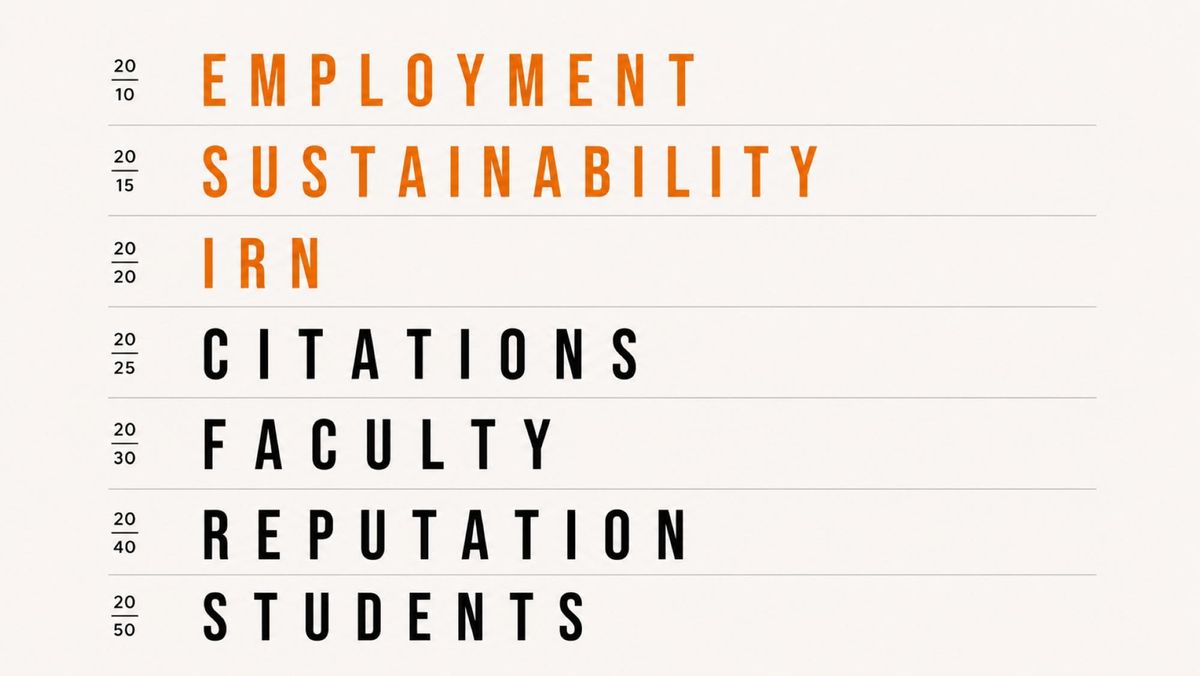
Welcome to a special 2027 QS World University Rankings edition of the QS Midweek Brief. In last year’s cover story, we observed that there are over 60,000 data points that make up the QS World University Rankings, from overall ranks and scores to indicator scores, ranks, changes and location data.
This year, we ask what can the rankings tell us about the world under a broad theme “How to read the world”. Inside is expert analysis and commentary on how the world has influenced the results, including signs of trouble ahead and promising shoots. This week, we look at India’s new trajectory, as it continues to climb the ranks.
Outside of the rankings, we also ask if the reversal of funding cuts, made by the short-lived Department of Government Efficiency – DOGE for short – can repair trust with external partners.
Stay insightful,
Anton John Crace
Editor in Chief, QS Insights Magazine
QS Quacquarelli Symonds

India’s new trajectory
By Gauri Kohli

In brief
- India’s higher education matures as record numbers of universities climb global rankings, moving beyond elite, established institutions.
- Ranked institutions surged 271% over a decade, making India the fastest-growing G20 nation in global academic representation.
- Future success hinges on improving internationalization and elevating quality across the broader ecosystem of state and affiliated colleges.
For years, India’s rankings story was largely defined by a small group of elite institutions. The QS World University Rankings 2027 tell a different story: one of expanding participation, broader gains in performance and a higher education sector that is steadily building depth along with excellence.
The key highlight is improved performances by institutions which are outside the elite Indian Institutes of Technology (IIT) ecosystem.
Beyond the elite IITs
QS data shows India is now the fastest-growing G20 nation by proportional increase in ranked universities. Over the past decade, India’s representation in the rankings has increased 271 percent from 14 to 52 institutions.
As per the 2027 edition of the rankings, IIT Delhi rose to 118, equalling the highest position an Indian university has ever achieved. India now places 11 universities in the world’s top 100 for research impact and six in the top 100 for employer reputation, and both of this year’s new entrants arrived on research strength alone – Bharathiar University enters at rank 75 globally for citations per faculty.
Notably, 26 of the 50 previously ranked Indian institutions improved their position this year while 18 universities reached their highest-ever ranking.
Other top ranked Indian institutions include IIT Bombay (at 134 globally), IIT Madras (improved 10 places from previous edition of the WUR and ranked 170), and Indian Institute of Science, Bangalore (at rank 221). In terms of other state and private institutions, the University of Delhi is among the top ranked from India securing a ranking of 322.
“Set against a field in which most US and German institutions declined, India’s improvement rate is among the strongest of any major system, second only to China among countries with more than 50 ranked universities,” QS data suggests.
Representation now spans 19 states and union territories, up from nine a decade ago, and ranked non-IIT institutions have grown from seven in 2017 to 43 today. Since the launch of NEP 2020, 29 Indian universities have reached their highest-ever ranking.
Dr Ashwin Fernandes, Vice President, Strategic and International Engagement QS Quacquarelli Symonds, says, “India’s rise is no longer driven by isolated pockets of excellence but by a broader strengthening of the higher education ecosystem. The path aligns with the country’s wider ambition towards research, innovation, employability and international competitiveness.”
This year, universities across multiple states, including public, private and multidisciplinary institutions, are increasingly improving their performance and achieving record positions.
“One of the major turning points has been the growing importance of employability and research impact. Indian universities are increasingly being recognised for academic output and for producing graduates who are valued by employers,” says Dr Fernandes.
The widening base of performance is also being reflected at the institutional level. Professor Suman Chakraborty, Director, IIT Kharagpur, says that Indian institutions were recognised primarily for producing outstanding human capital earlier. “Today, they are being recognised for creating new knowledge, driving innovation, nurturing entrepreneurship and addressing grand societal challenges at a global scale,” he adds.
Professor Chakraborty points to a conscious shift at the institution from being a centre of excellence to becoming an ecosystem of impact as the reason for its progress.
“We are strengthening interdisciplinary research, expanding global partnerships, and accelerating deep-technology translation, fostering startups, and building solutions in areas such as healthcare, sustainability and artificial intelligence. The objective is not merely to improve ranking metrics, but to enhance the real-world relevance and global visibility of our contributions,” Professor Chakraborty tells QS Insights.
In this year’s edition of the QS World University Rankings, IIT Kharagpur improved 10 places from the previous year and ranked 205.
Similar trends are being observed at other institutions. Professor Amit Patra, Director of IIT (BHU) Varanasi, says his institute’s improved rankings performance has been driven by investments in research, international visibility and academic partnerships.
“The academic landscape in India has shown steady progress towards being among the top 100 globally, with some institutions coming increasingly closer to that target,” he says.
Reflecting on the performance of the institute in the QS World University Rankings, Professor Patra says it shows a steady upward trend from the first appearance in 2023 where it was ranked in 651-700 band to a rank of 531 in the 2026 edition.
This year, IIT BHU’s rank has improved 56 places to 510 from last year.
From expansion to quality
While earlier efforts by institutions, governments and higher education bodies focused largely on expanding access, recent reforms have increasingly emphasised quality, research, innovation and competitiveness internationally.
Professor Dhirendra Pal Singh, former Chairman of the University Grants Commission and former Director of the National Assessment and Accreditation Council, believes the development of a more competitive environment has played an important role in improving institutional performance.
“Students and parents see rankings as a key indicator of quality, and there is prestige attached to institutions that perform well on them. All stakeholders have realised that quality pays in the long run,” Professor Singh tells QS Insights.
“The improving performance of Indian universities in the QS World University Rankings reflects a greater focus on quality and on indicators such as citations per faculty, international faculty and international research networks.”
He highlights a series of policy initiatives that have helped shape this progress, including accreditation reforms, the Institutes of Eminence initiative and the introduction of India’s own National Institutional Ranking Framework (NIRF).
Dr Fernandes argues that the NEP 2020 has encouraged multidisciplinary learning, institutional autonomy and stronger research cultures, while increasing focus on international benchmarks.
“Universities are becoming part of the national development story rather than operating separately from it,” he says.
He also notes that the geographical spread of success is becoming increasingly significant. Institutions across states are performing well, which suggests Indian higher education is no longer confined to a few established centres of excellence.
Sustaining momentum
This year, all of India’s top 10 universities improved on employer reputation, while the University of Mumbai rose to 25 globally for employment outcomes.
Dr Fernandes identifies research impact, employer reputation and graduate employability as areas where Indian institutions have recorded some of their strongest gains.
Yet internationalisation remains a structural challenge. While many institutions are producing high-quality research and graduates, these strengths are not always matched by levels of international faculty recruitment, student enrolment and global academic recognition seen in leading higher education systems.
For Professor Singh, sustaining momentum will require improvements beyond India’s top-performing institutions. He says that improving the quality of affiliated colleges and strengthening teaching, learning and research across state universities will be critical.
The next phase of India’s ascent will not be defined by incremental improvements in rankings alone. “It will be defined by our ability to advance our institutions to globally respected universities that combine excellence with accessibility, high-quality research with societal impact,” says Professor Chakraborty.
Gauri Kohli specialises in writing and reporting on higher education news, including analysis on higher education trends, policies and the edtech sector. Her writing focuses on international education, study abroad, student recruitment trends and policies, with focus on India as a market. She has also covered workplace and hiring trends, corporate practices, work-life features, startup trends and developments, real estate for leading publications and media houses in India and abroad for the last 18 years, including Hindustan Times, a leading national daily newspaper in India.
Can US research get out of the DOGEhouse?
By Seb Murray

In brief
- US court reverses "unconstitutional" mass research cuts triggered by the government’s DOGE automated tools.
- Grants were targeted via political keywords, fuelling fears of self-censorship and destabilising vital international academic collaborations.
- Restoring funds is easier than rebuilding trust, as global partners now seek more reliable, stable international research alternatives.
In April last year, an axe fell on more than 1,400 research grants in the US, disrupting – and in some cases halting – ongoing projects and throwing many universities and cultural institutions across the world’s largest economy into disarray.
The cuts, carried out by the Trump administration’s Department of Government Efficiency (DOGE), were noted not only for being so wide sweeping, but also because of the unusual way in which they were executed.
Court filings from legal challenges by academic associations and individual researchers showed that officials had used automated tools including ChatGPT and keyword searches linked to political priorities – terms such as “LGBTQ” and “immigration” – to flag grants for termination.
Then in May this year, a federal judge ruled the cuts unconstitutional, citing “irreparable injury” and a broader “chilling effect” on academic work.
The ruling ordered some $100 million in funding be restored. But for many research partners, the damage was already done. “Research requires long-term commitment, and interruptions in such commitments have a negative impact on quality and impact,” says Hans de Wit, Professor Emeritus and former Director of the Center for International Higher Education at Boston College.
For universities and research partners abroad, that uncertainty is causing them not to walk away from the US, but to rely on it a little less. Trust in the US research system is not collapsing, but it is fragmenting.
“There is still substantial trust in American scientists and even in their institutions as highly qualified partners,” de Wit says. “But there is increasing concern about funding, self-censorship pressures, data protection, knowledge security and political and economic instability.”
The US continues to be a leader in research globally, with many of the world’s leading universities and deepest funding pools. But confidence in the policy environment surrounding those institutions is beginning to ebb, according to Janet Ilieva, Founder and Director of Education Insight, a higher education research consultancy.
“I would distinguish between institutional trust in US universities, which remains strong, and confidence in the policy environment around them, which appears to have weakened,” says Dr Ilieva.
DOGE brought those concerns into sharper focus. The reversal of grants, the use of keyword searches and the reliance on automated tools have prompted fresh questions about how funding choices are determined, and how reliable the US research system is.
For many outside the country, the issue is not simply that funding was cut. It is that it could be cut this way.
One early sign of a more risk-based view of the US is showing up in student flows.
“While narrowing down a set of universities could be determined by factors such as cost and rankings, choosing which country to study in is highly influenced by perceived risks and benefits,” says Rahul Choudaha, an analyst of international student mobility trends at DrEducation Research.
Seb Murray is a journalist and editor who writes often for the Financial Times and has written for The Times, The Guardian, The Economist, The Evening Standard and BBC Worklife. He focuses on higher education and global business. He also produces a wide range of content for a range of corporate and academic institutions. Seb is also a recognised expert on higher education and speaks at international conferences.